
Why Understanding Retaining Wall Replacement Costs Matters

When a retaining wall shows signs of failure, understanding the retaining wall replacement cost is critical for protecting your property and budgeting intelligently. A failing wall is more than an eyesore; it can trigger slope instability, soil loss, drainage problems, and damage to adjacent structures or landscaping. In the worst cases, collapse risks safety and can result in emergency repair bills far exceeding a planned replacement.
Quick Cost Overview:
- Average total cost: $6,000 – $14,000 for a typical 50-foot wall
- Cost per square foot (installed): $20 – $53 and higher for specialized conditions
- Material range: roughly $10 (vinyl) to $90+ (natural stone) per square foot
- Demolition and removal: commonly $10 – $30 per linear foot additional, depending on material
These figures reflect national internet averages and are not pricing for George Hardscaping; local conditions in Essex County, MA, and your site’s specifics will ultimately determine the final number. Unlike spot fixes, a full replacement includes demolishing and hauling away the old wall, correcting base and drainage issues, and building a new, code-compliant system with proper footing depth, backfill, and water management.
Why cost clarity matters now:
- Risk reduction: Walls that lean, bow, or crack are signaling distress. The sooner you address root causes (often drainage and base failures), the lower your risk and total spend.
- Budget control: Replacement projects have several components—engineering (for taller walls), permitting, demolition, excavation, base prep, materials, drainage, and finish details. Knowing each cost category helps you plan and prioritize.
- Value and longevity: Properly rebuilt walls protect yards, driveways, patios, and foundations. A well-constructed concrete or stone wall with robust drainage can last 50 to 100+ years, making the expense a long-term investment in your property’s safety and curb appeal.
If you’re weighing options for your home, explore how our team approaches structure, drainage, and finishes on our landscape retaining wall service page: landscape retaining walls. For broader project scopes that combine walls with patios, steps, or walkways, view our hardscaping and masonry services.
Strong call to action: If your wall is leaning, cracking, or showing bulges, do not wait for a collapse. Request a detailed estimate from George Hardscaping and get a clear, line-item proposal for a code-compliant, long-lasting replacement.
Understanding the Average Retaining Wall Replacement Cost
When you’re facing a failing structure, understanding the full retaining wall replacement cost helps you plan, compare bids appropriately, and avoid surprise change orders. Replacement is a complete process—from safe demolition and disposal to site prep, base construction, drainage, and the finished wall.
National Averages and Price Per Square Foot
While actual pricing depends on site variables, national internet data suggest most homeowners invest between roughly $6,000 and $18,000 to replace a typical residential retaining wall, with common installed price ranges of $20 to $60 per square foot. These are not George Hardscaping’s rates and should be used only as general planning guidance.
Sample scenarios using square-foot pricing:
- Small garden wall (3 feet tall x 20 feet long = 60 sq. ft.): $1,200 to $3,600 for basic materials in easy access conditions; add demolition/disposal and any drainage upgrades.
- Mid-size wall (4 feet tall x 40 feet long = 160 sq. ft.): $3,200 to $9,600 plus demolition/disposal. Engineering review may be required at or above 4 feet.
- Large wall (6 feet tall x 50 feet long = 300 sq. ft.): $6,000 to $18,000+ depending on material, engineering, and drainage/surcharge conditions. Taller walls typically require deeper footings and more robust reinforcement.
Linear foot vs. square foot:
- Many contractors quote by square foot (height × length), because wall height drives base depth, backfill, geogrid, and safety factors. Some line items (like demolition) may be quoted per linear foot because height influences disposal less than material type and access.
Above about 4 feet, most jurisdictions require engineering for safety. In Massachusetts, local building departments apply the Massachusetts State Building Code (780 CMR), based on the International Building Code (IBC). For reference, see the state code portal at Massachusetts State Building Code (780 CMR) and the IBC’s chapter on soils and foundations at the International Code Council: International Building Code, Chapter 18. Your project may also need permits; a reputable contractor will help identify and obtain them.
For projects where the retaining wall supports a driveway, slope, or structure, plan on professional engineering and enhanced drainage. If you’re integrating stairs or terraces, costs rise with complexity—curves, corners, and built-in lighting require more labor and precision. To see how walls, steps, and masonry features come together, browse our hardscaping and masonry services and steps and brick stairs.
Cost Breakdown by Material
Material choice significantly affects price, longevity, and look. Below are common materials seen in New England and their typical installed ranges from national internet sources (not George Hardscaping’s pricing):
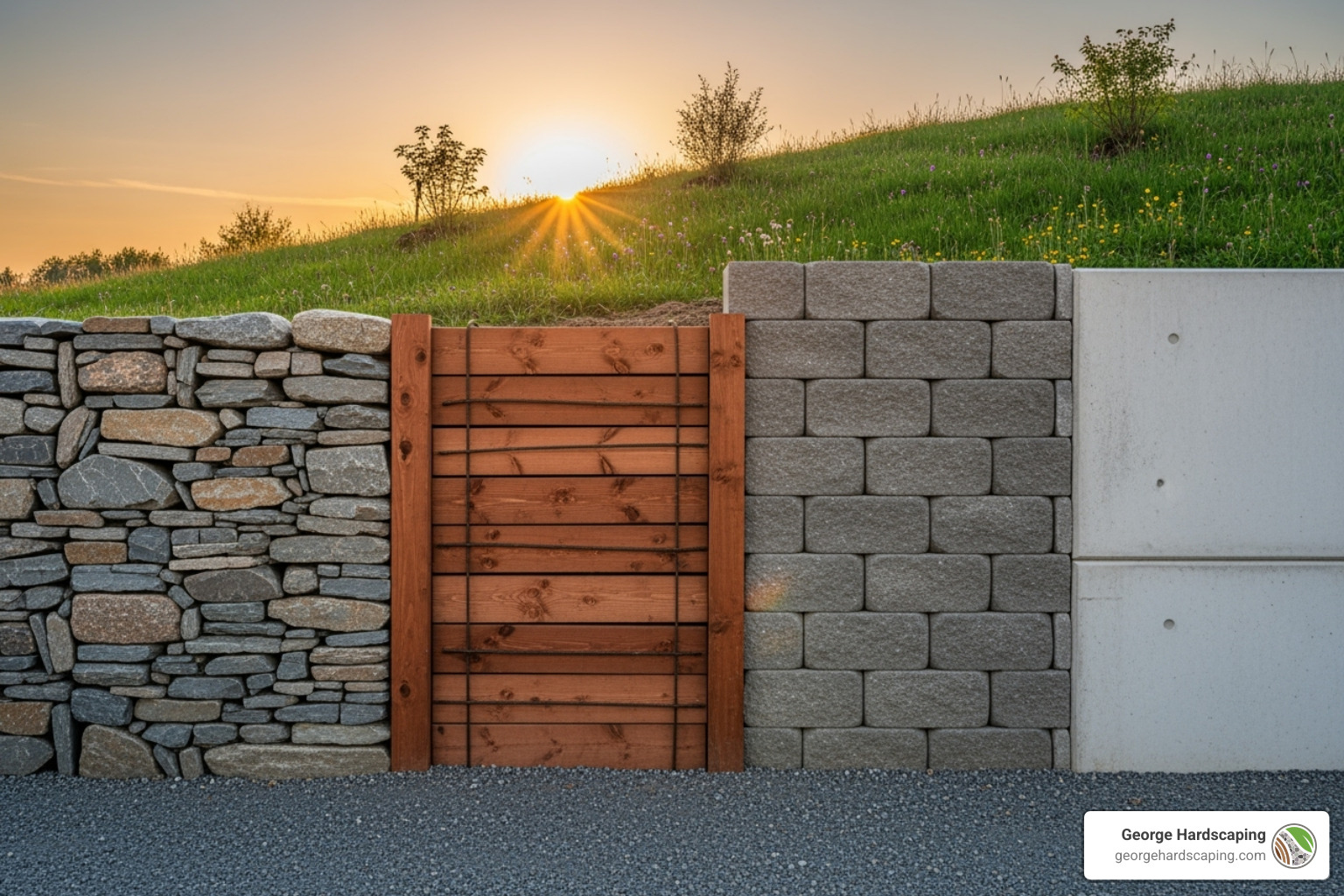
Concrete blocks (segmental systems): Roughly $15 to $45 per square foot installed. Attractive, modular, and engineered options exist for tall walls. Lifespan: 50 to 100 years with proper drainage.
Poured concrete: Around $20 to $60 per square foot installed. Strong, continuous, and especially suitable for high loads or tight spaces. Can be faced for aesthetics. Lifespan: 50 to 100 years with proper drainage and waterproofing.
Natural stone: About $25 to $90 per square foot installed. Highest curb appeal and excellent longevity. Requires skilled masons. Lifespan: 100 to 200+ years if built on a solid base with drainage.
Wood/timber: Approximately $13 to $35 per square foot installed. Lower upfront cost; appearance can fit rustic settings. Lifespan: 10 to 40 years. Requires maintenance and careful selection of treated materials. Note: Creosote-treated railroad ties are restricted/banned in many places due to toxicity; see the U.S. EPA overview on creosote: EPA: Creosote.
Vinyl/composite: Typically $10 to $15 per square foot installed for short, decorative walls. Lightweight and low maintenance. Lifespan: Around 50 years for appropriate applications.
What’s included vs. extra:
- Typically included in installed pricing: excavation for base, compacted aggregate, the wall material, standard backfill, and basic drainage.
- Often additional: engineering and permits (especially at ≥4 feet), demolition/disposal of the old wall, access challenges (hand carry), specialty drainage solutions, and features like lighting or caps.
The Cost of Demolition and Removal
Before you rebuild, the old wall must be demolished safely and disposed of correctly. Demolition commonly adds $10 to $30 per linear foot, depending on height and material. Concrete and stone require more labor and specialized tools to break up. Disposal fees range with local rates; expect a few hundred dollars to haul and tip heavy materials. If your old wall includes creosote-treated timbers, anticipate hazardous material handling and higher disposal costs.
After the tear-out, site prep may reveal hidden issues—buried obstacles, utility lines, or soft subgrade—each can influence time and cost. In New England, always notify Dig Safe before excavation to locate underground utilities: Dig Safe (Call 811).
If you want a durable, code-compliant solution with long-term drainage control, speak with our team. We regularly combine retaining walls with regraded yards, steps, and new hardscapes. View our approach and portfolio on landscape retaining walls and the gallery.
Key Factors That Influence Your Final Price
Beyond size and material, several technical and site-specific variables significantly impact your retaining wall replacement cost. Understanding these factors helps you interpret bids accurately and budget without unpleasant surprises.
1) Wall Size, Height, and Design Complexity
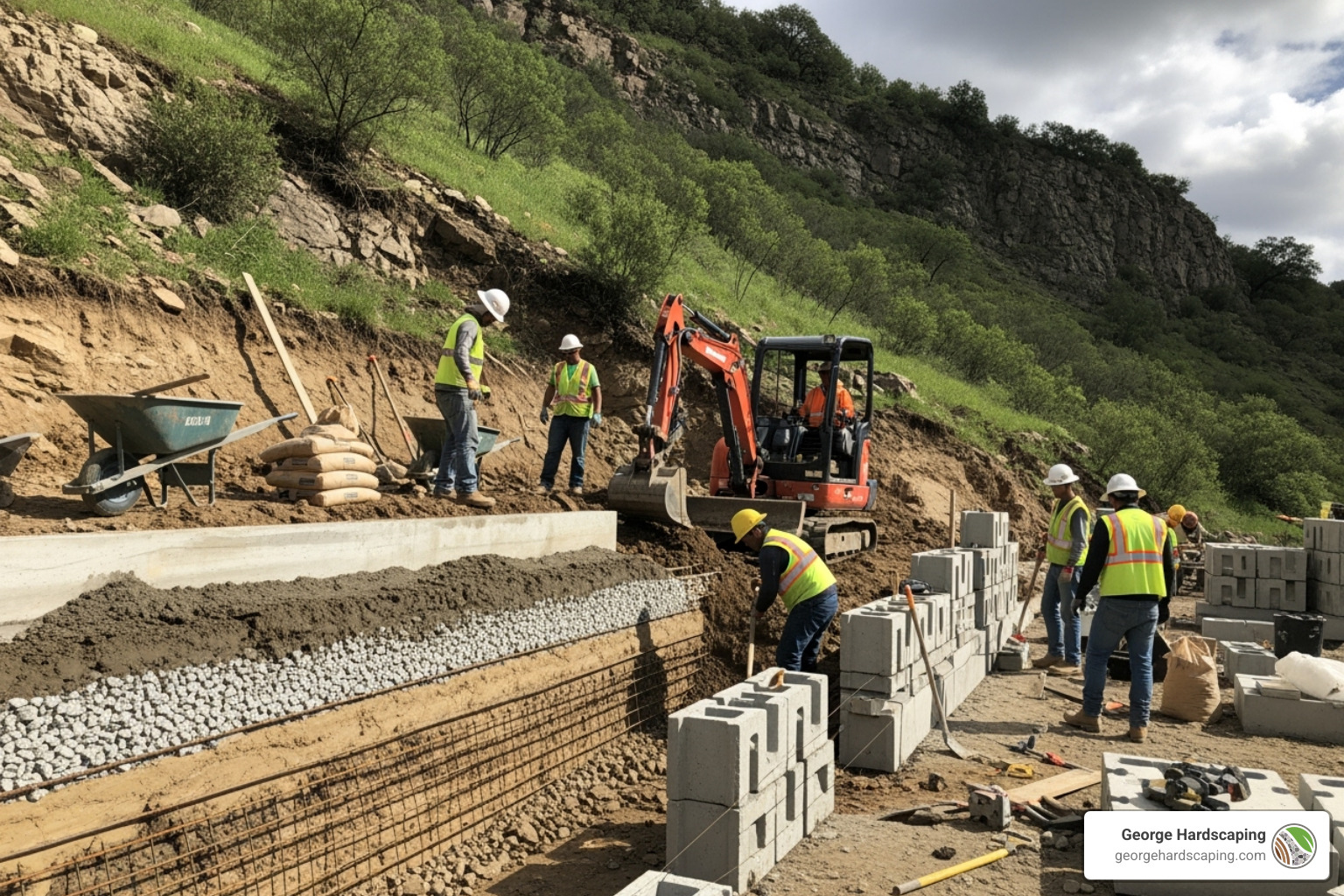
Square footage is the basic driver, but height adds complexity fast. A 6-foot wall can be more than twice the cost of a 3-foot wall, because taller walls often require:
- Deeper, wider base excavation and stronger footing
- Geogrid reinforcement or tie-backs
- Thicker or heavier units (or poured sections) and higher labor time
- Engineer-stamped drawings and inspections
Curves, steps, corners, and terraced layouts add cutting, alignment, and staging time. Features such as integrated lighting, stone caps, or veneer finishes increase material and labor. Terracing can be a smart way to handle grade while reducing the structural demand on any single wall, but remember you are essentially building multiple walls.
2) Loads, Setbacks, and What’s Near the Wall
The lateral earth pressure a wall must resist is multiplied by surcharge loads. Surcharges include driveways, parked vehicles, sheds, pools, slopes above the wall, and adjacent structures. If the wall supports or is close to these, the design must account for higher forces.
- Setbacks from property lines or public rights-of-way can constrain base width and backfill zone.
- Proximity to buildings, decks, or fences raises safety and access considerations.
- If you plan a driveway or patio above/below, inform your contractor—reinforcement and base detail may change.
For deeper technical guidance on reinforced soil structures and retaining wall design, see the Federal Highway Administration’s reference for MSE walls: FHWA-NHI-07-071. These concepts inform best practices even on residential projects.
3) Soil Conditions and Drainage Requirements
Soil is fundamental. Sand and gravel drain well and exert lower hydrostatic pressure. Clay holds water, increasing lateral pressure and driving most failures. If you have dense clay or a high water table, plan on more robust drainage and possibly deeper excavation to reach competent subgrade.
Typical professional drainage plan components:
- Free-draining backfill (clean, angular gravel) behind the wall
- A perforated drain pipe (French drain) at the base, sloped to daylight or a drain basin
- Filter fabric to prevent fines from clogging the drainage zone
- Weep holes (for certain wall types)
- Waterproofing membranes on soil-facing sides for poured concrete or faced systems
Drainage is not optional. It’s the most critical factor in wall longevity. It may add 15–25% to the project cost, but it prevents the hydrostatic pressure that otherwise bows, tilts, and cracks walls over time.
4) Frost, Footing Depth, and New England Climate
In Massachusetts, frost depth and freeze-thaw cycles influence how deep your base and footing must be to prevent heaving and displacement. Local building officials enforce requirements under the Massachusetts State Building Code (780 CMR). For reference, review the code portal at Massachusetts State Building Code (780 CMR) and the IBC foundation guidelines: IBC 2021, Chapter 18.
What that means for cost:
- Deeper excavation and more base material for frost-resistant construction
- Higher labor time for winter builds and weather protection
- Additional drainage and waterproofing to manage snowmelt and spring runoff
5) Access and Site Logistics
Access constraints often surprise budgets. When machinery cannot reach the site, crews must hand-carry blocks, stone, and demo debris. This elevates labor hours and may require temporary ramps or staging. Consider:
- Narrow side yards, slopes, or tight gates
- Protecting lawns, gardens, or hardscapes during material handling
- On-site stockpile and maneuver room for aggregate and block pallets
If large boulders, ledge, or tree stumps are encountered during excavation, allowances may be needed for rock breaking, stump removal, or arborist work. If you suspect utilities, irrigation, or invisible fences in the work zone, contact Dig Safe before excavation: Dig Safe (Call 811).
6) Permits, Engineering, and Inspections
Most Massachusetts towns require permits for walls at or above 4 feet, and some require permits for shorter walls depending on location or load. Engineer-stamped drawings are frequently needed for tall or loaded walls. Expect:
- Structural engineering fees: commonly $350 to $750 for a straightforward residential wall; more for complex conditions
- Permit fees: often $40 to $450, varying by municipality
- Possible conservation or stormwater reviews near wetlands or water bodies
Your contractor should help navigate local rules. Walls built to code reduce risk, improve resale, and help ensure insurance compliance. For broader industry best practices, see the Mason Contractors Association of America: MCAA.
7) Demolition, Disposal, and Environmental Handling
Material type affects demo effort. Concrete and stone require cutting, breaking, and heavy hauling. Wood walls with decayed or creosote-treated timbers can entail environmental precautions. Disposal fees vary by weight and material. If creosote-treated wood is present, you may face specialty disposal in accordance with EPA guidance: EPA: Creosote.
8) Choosing the Right System for Your Site
The “best” wall is site-specific. Segmental block systems are versatile and can be engineered for tall heights. Poured concrete is strong and compact, often ideal where space is tight or loads are high. Natural stone offers unmatched character and longevity, provided the base and drainage are executed to modern standards. Timber can suit small, decorative applications when budget is the priority and lifespan expectations are modest.
If you’re unsure which system fits your home, talk to a professional who will review soils, loads, drainage, aesthetics, and budget. Our team regularly combines walls with steps and terraces to create safe, usable outdoor spaces. See examples and get inspiration in our gallery and learn about our steps and brick stairs.
9) Codes, Standards, and References to Know
Well-built walls are anchored in established engineering. In addition to state and local codes, good references include:
- International Building Code (IBC) soils and foundations: ICC – IBC Chapter 18
- Massachusetts State Building Code portal: Massachusetts 780 CMR
- FHWA guidance on reinforced soil walls: FHWA-NHI-07-071
These resources inform best practices used by responsible contractors—even for residential projects—so your investment performs for decades.
For walls in challenging conditions, investing in design and drainage now is the most cost-effective path. To see how we implement these fundamentals across Essex County, explore our landscape retaining walls and broader hardscaping and masonry services.
Repair or Replace? Making the Right Financial Decision
The choice between repairing a damaged wall and completing a full replacement depends on cause, severity, and risk. Cosmetic fixes on a structurally compromised wall are “band-aids” at best and can set you up for repeated failures.
When a Targeted Repair Can Make Sense
Modest, localized issues can sometimes be addressed cost-effectively (often $250 to $1,250 for small repairs per national internet averages; not George Hardscaping pricing):
- Hairline cracks that are not growing and show no pattern of displacement
- Minor spalling or efflorescence on concrete where drainage is otherwise effective
- Small, isolated sections of rot in a timber wall that can be removed and replaced
- Slight, localized leaning under about 2 inches that can be corrected with reinforcement anchors where appropriate
Before proceeding, confirm that drainage is correct. Any repair should include steps to redirect water and relieve pressure; otherwise, new cracks and tilting can reappear quickly.
When Replacement Is the Smart and Safe Choice
If any of the following are present, replacement is usually the prudent decision:
- Noticeable leaning or bowing (several inches) or a progressive tilt over time
- Structural cracks wider than about 1/4 inch, especially if spanning long sections
- A shifting or undermined base/foundation
- Widespread rot in wood walls or loose, displaced stones in dry-stacked systems
- Absent or inadequate drainage in the original build, leading to recurrent failures
- The wall is at the end of its expected lifespan (common with older timber walls)
Older walls often fail because they were built without modern drainage, geogrid, or code-level footing depth. In those cases, replacement addresses root causes, restores safety, and reduces long-term costs.
How to Decide Confidently
- Document the symptoms: photos over time help show progression (lean, cracks, bulges)
- Ask for a root-cause assessment: soils, loads, and drainage conditions
- Request a line-item estimate that includes demolition, drainage, base construction, and finishes
- Seek clarity on code and permit requirements in your town
- Consider the risk of deferring: if failure jeopardizes a driveway, patio, or structure, replacement is often the lower-risk, lower-total-cost approach
If you want a second opinion, consult your local building department or review code references such as the International Building Code, Chapter 18.
Strong call to action: Ready for a professional assessment? Schedule a site visit and get an itemized, code-compliant plan. Request your estimate now. To see what a successful replacement looks like, browse before-and-after photos in our gallery.
Frequently Asked Questions about Retaining Wall Replacement
Homeowners researching retaining wall replacement cost often share similar questions. The answers below are based on national internet averages and industry best practices and are not pricing for George Hardscaping.
What is the cheapest material for a retaining wall replacement?
Vinyl or composite systems and certain timber options are typically the lowest-cost solutions for small, decorative walls. That said, investing in segmental concrete blocks usually delivers the best value because of their lifespan (often 50–100 years with proper drainage) and modular engineering options for taller walls. If budget is the priority in the short term, be realistic about maintenance and replacement timelines on wood.
How long should a new retaining wall last?
- Wood/timber: 10–40 years depending on treatment, drainage, exposure, and maintenance
- Concrete blocks or poured concrete: 50–100 years with correct base and drainage
- Natural stone: 100–200+ years when properly founded and drained
Drainage quality is the single most important longevity factor.
Do I need a permit to replace my retaining wall in Massachusetts?
Permit requirements vary by town and wall height, location, and load. Many communities require permits at or above 4 feet and may require them for shorter walls near property lines, driveways, or public ways. Engineer-stamped drawings can be required for taller or loaded walls. Consult your local building department and the state code portal: Massachusetts State Building Code (780 CMR). For code foundation guidance, see International Building Code, Chapter 18. We assist clients with permitting in Essex County.
How much does demolition and removal usually add to the cost?
Expect about $10–$30 per linear foot for demolition, plus hauling and disposal fees that reflect material weight and landll rates. Concrete and stone cost more to break up and dispose of than timber. If creosote-treated railroad ties are present, hazardous handling and disposal rules apply; see EPA: Creosote. Plan for disposal line-items in your estimate.
What design choices affect cost the most?
- Height and surcharges (driveways, slopes, structures) that require more robust design
- Drainage system quality (gravel backfill, perforated pipe, fabric, waterproofing)
- Material choice (stone and custom finishes cost more; timber costs less but has shorter lifespan)
- Access and logistics (hand-carry, narrow gates, steep slopes)
- Engineering, permitting, and inspections
What are the signs I should replace, not repair?
Severe leaning or bowing, large and growing cracks, base movement, widespread rot in wood, or repeated failures due to absent drainage are typical indicators for replacement. If the wall supports a driveway, patio, or structure—or if there is a public safety concern—replacement is almost always the safer option.
Can I DIY a retaining wall replacement?
Homeowners can handle small, low garden walls on easy sites, but structural walls require excavation safety, compaction, code knowledge, and drainage engineering. Mistakes can be expensive, unsafe, and may violate code. At minimum, consult a professional for walls taller than 3–4 feet or supporting any load. Always contact utility locating services before digging: Dig Safe (Call 811).
How long does a typical project take?
Small replacements can finish in 2–4 days. Mid-size projects often take 1–2 weeks. Larger or engineered walls can extend to several weeks due to demolition, excavation, inspections, and staging. Weather and site conditions also affect schedule.
What time of year is best for replacement?
Late spring through fall offers optimal conditions in New England. Winter builds are possible but may require frost mitigation, weather protection, and heat for certain materials, which can add cost. If your wall is at risk of failure, do not wait for ideal weather—interim stabilization and expedited replacement can prevent bigger losses.
What kind of warranties should I expect?
Materials often come with manufacturer warranties. Reputable contractors also provide workmanship warranties. Clarify coverage on base settlement, drainage performance, and any exclusions. A warranty is most meaningful when the wall is built to code with proper drainage and compaction.
Will adding steps or terraces increase cost?
Yes. Stairs, landings, lighting, and terraced layouts add materials, cutting, and precise labor. Terraces are often favored for very steep slopes because they reduce the load on any single wall and create usable garden or seating areas. Explore examples on our steps and brick stairs page and see completed spaces in our gallery.
How do I compare contractor estimates fairly?
Request apples-to-apples proposals with line items for:
- Demolition and disposal (by material)
- Excavation depth and base specifications
- Drainage components (gravel type, pipe, fabric, discharge location)
- Material brand/type and cap details
- Engineering, permits, and inspection allowances
- Access logistics, protection of landscaping, and cleanup
Also ask about crew experience, licensing, insurance, and code familiarity. Memberships in professional organizations like the Mason Contractors Association of America can indicate a commitment to best practices.
Can I combine my wall project with other hardscaping?
Absolutely. Many homeowners pair a wall replacement with new steps, a walkway, or regrading to improve function and drainage. Bundling reduces disruptions and can improve overall design and value. Explore our capabilities on hardscaping and masonry services and specialized landscape retaining walls.
If you need a code-compliant, long-lasting solution tailored to your property, get professional guidance early. Strong call to action: Start with a site visit and a clear plan. Request your estimate today.
Conclusion: Investing in a Safe and Beautiful Landscape
Understanding retaining wall replacement cost helps you plan a resilient, long-term solution. While price depends on height, materials, access, engineering, and drainage, the right system protects your property, manages water, and can enhance curb appeal for decades. In Essex County’s climate and terrain, attention to drainage, base preparation, and code requirements makes all the difference between a short-term fix and a lasting investment.
Strong call to action: If your wall shows signs of failure—or if you want a more functional, attractive landscape—partner with a contractor who designs for longevity. Request a detailed estimate from George Hardscaping and see what’s possible in our gallery. For walls integrated with steps, patios, and masonry features, learn more about our hardscaping and masonry services.