
Landscape stone steps: Elevate Your Home 2025
Why Landscape Stone Steps Are the Foundation of a Beautiful, Functional Outdoor Space
Landscape stone steps are far more than just a functional solution for moving between different levels of your property—they are a foundational design statement that marries timeless, elemental beauty with enduring practicality. Whether you envision a grand, welcoming entrance that boosts your home’s curb appeal, a rustic path that meanders through a sloping backyard, or a seamless transition connecting your patio to the wider landscape, natural stone steps offer a unique combination of durability, character, and lasting value that manufactured materials simply cannot replicate. They are the architectural bones of a well-designed garden, guiding movement, creating visual interest, and grounding the home in its natural surroundings.
Quick Answer: What You Need to Know About Landscape Stone Steps
- Unmatched Durability: Natural stone steps possess immense weight and density, which means they rarely shift, settle, or heave over time. This inherent stability makes them the superior choice for high-traffic areas and climates with significant ground movement.
- Timeless Aesthetic Appeal: Available in a diverse palette of materials like granite, bluestone, limestone, and fieldstone, each type of stone offers unique colors, textures, and patterns that can complement any landscape style, from modern minimalist to classic colonial or rustic cottage.
- Versatile Applications: Stone steps are incredibly adaptable. They are perfect for creating impressive front entrances, crafting enchanting garden pathways, designing elegant patio and deck transitions, and safely navigating steep or gentle slopes.
- Critical Installation Process: A successful, long-lasting installation is non-negotiable. It requires a professionally prepared, compacted gravel base of at least 4-6 inches, meticulous planning for proper drainage, and expert craftsmanship to ensure stability for decades.
- Low-Maintenance Longevity: Once installed, natural stone is exceptionally low-maintenance. It is inherently weather-resistant and can be kept in pristine condition with basic care, such as periodic cleaning and sealing every 2-3 years to protect against staining and moisture.
- Significant Investment Value: While the initial cost is higher than other materials, the long-term value is unparalleled. Materials can range from $85 to over $400 per step (based on internet averages, not George Hardscaping pricing), and professional installation ensures this investment enhances both curb appeal and property resale value.
For homeowners throughout Essex County and the North Shore of Massachusetts, the region’s notorious freeze-thaw cycles and naturally varied terrain make the choice of outdoor materials absolutely critical. Wood inevitably succumbs to rot and warping, while concrete is prone to cracking and spalling under relentless seasonal stress. In stark contrast, natural stone steps hold up well in all kinds of weather, from the harsh summer sun to heavy snow and rain, ensuring your outdoor spaces remain safe, accessible, and beautiful year after year. They integrate organically with the rolling slopes common in New England, becoming a permanent, low-maintenance feature that feels as though it has always been part of the land.
In this comprehensive guide, we’ll explore inspiring stone step ideas for every part of your property, help you select the perfect stone for your needs, and detail the professional installation and maintenance practices that guarantee they will last for generations. If you’re struggling with a sloped yard or wish to connect your outdoor living areas more elegantly and seamlessly, professionally installed stone steps are the transformative solution you’ve been looking for. Our hardscaping and masonry services at George Hardscaping bring decades of specialized experience working with natural stone in the unique and demanding conditions of the North Shore.
Why Choose Natural Stone Steps Over Wood or Concrete?
When planning an outdoor staircase, the material you select does more than just serve a function; it defines the aesthetic, dictates future maintenance, and determines the long-term performance of your landscape. While wood offers a certain natural warmth and poured concrete presents an affordable initial option, landscape stone steps exist in a superior category of their own. After years of designing and completing installations throughout Essex County, we have seen firsthand that natural stone provides an unmatched trifecta of durability, weather resistance, and a timeless aesthetic that never falls out of style.
Wood steps, for all their initial charm, begin a battle against nature from day one. They are vulnerable to moisture, leading to rot, warping, and splintering. They require constant, diligent maintenance—sanding, staining, and sealing—to postpone their inevitable decay and can become a host for algae, mold, and destructive insects.
Concrete, though seemingly a robust and practical alternative, is highly susceptible to the punishing freeze-thaw cycles common in Massachusetts. Water penetrates its porous surface, freezes, expands, and creates cracks, spalling, and heaving, turning a once-smooth surface into a hazardous and unsightly problem. Natural stone, however, is forged by the earth and built to last. Stone steps for landscaping integrate with your property’s terrain, becoming a permanent, structural feature that only improves with age.
The Enduring Strength and Beauty of Natural Stone
There’s a profound, reassuring feeling that comes from walking on solid stone steps. This sense of stability is not just psychological; it’s a direct result of physics. Natural stone steps and treads rarely shift over time due to their sheer mass and weight. A single granite or bluestone step can weigh several hundred pounds, anchoring itself into the landscape and providing a level of permanence that lighter materials cannot achieve. This inherent stability makes them the ideal, worry-free solution for any application, from a heavily used front entrance to a secluded garden path.
Unlike its counterparts, natural stone holds up well in all kinds of weather, from harsh sun to heavy rain, and effortlessly handles the expansion and contraction of freeze-thaw cycles. This exceptional durability makes stone a true long-term investment, effectively eliminating the recurring costs and labor associated with repairing or replacing wood or concrete. For homeowners who want to spend their time enjoying their outdoor spaces rather than constantly maintaining them, this peace of mind is invaluable. Learn more about our masonry services to see how expertly laid stone forms the foundation of truly lasting outdoor structures.
Beyond its formidable strength, natural stone possesses a unique and authentic beauty. Each piece is a work of art from nature, with distinct variations in color, veining, texture, and pattern. Monolithic granite steps can be used to create a sleek, formal, and modern entrance, while irregularly shaped fieldstone steps offer a rustic, organic charm that feels deeply connected to the earth.
This incredible versatility allows the material to adapt to your specific architectural style and personal vision. Stone also integrates seamlessly with the surrounding landscape, echoing the natural tones of soil, bark, and foliage. This aesthetic quality only deepens over time as the stone develops a rich, natural patina. To see how we’ve utilized a variety of stone types to achieve different effects, explore our gallery of completed projects.
| Feature | Natural Stone | Concrete | Wood |
|---|---|---|---|
| Durability | Excellent; extremely long-lasting, weather-resistant, rarely shifts. | Good; prone to cracking and spalling over time, especially with freeze-thaw cycles. | Fair; susceptible to rot, warping, and insect damage; requires frequent maintenance. |
| Aesthetics | Superior; unique, natural variations in color and texture; timeless beauty. | Uniform; can be stamped or colored but often lacks natural character and depth. | Natural initially; can fade, splinter, and look worn without constant upkeep. |
| Maintenance | Low; occasional cleaning and optional sealing; highly resistant to wear. | Moderate; requires sealing to prevent staining and water damage; repairs can be noticeable. | High; requires regular sealing, staining, or painting; prone to structural issues. |
| Stability | Excellent; enormous weight provides inherent stability against heaving and settling. | Good; can settle and crack if the base is not properly prepared and compacted. | Fair; can shift, sag, and become uneven over time as wood degrades and fasteners loosen. |
| Long-Term Value | High; significant increase in curb appeal and resale value; a permanent improvement. | Moderate; functional but adds less aesthetic or financial value compared to stone. | Low to Moderate; can detract from value if not perfectly maintained. |
| Environmental Impact | Good; long lifespan and potential for local sourcing reduces overall impact. | Poor; cement production is energy-intensive and a major source of CO2 emissions. | Moderate; depends on sourcing (FSC-certified vs. not) and chemical treatments. |
While the initial investment for natural stone is higher, its incredible longevity, minimal maintenance requirements, and substantial contribution to property value offer superior long-term financial returns. Stone steps allow for safe and attractive movement between levels, elegantly following the natural contours of your property. This is especially important in the North Shore region, where varied topography is a common and beautiful feature of the landscape.
Inspiring Stone Step Designs for Every Part of Your Landscape
Every corner of your property tells a story, and landscape stone steps can be the beautiful, functional punctuation marks that bring clarity, flow, and elegance to that narrative. They are a unique opportunity to transform functional necessities into deliberate design features, whether they are welcoming guests at your front door, meandering gracefully through a garden, or connecting your patio to the yard below.
Stone steps are about creating moments and experiences—a grand entrance that makes a statement, an inviting path that encourages exploration, or a seamless flow that merges indoor and outdoor living. Discover more natural stone steps ideas that showcase the incredible versatility of this timeless material.
Grand Entrances: Welcoming Front Door Steps
Your front entrance is the first impression your home makes, and it’s an investment in curb appeal that pays dividends in both pride of ownership and property value. Wide, inviting monolithic granite steps bring an immediate sense of permanence, quality, and sophistication. A clean, sawn and thermal finish creates crisp, modern lines perfect for contemporary homes, while a rugged rockfaced finish adds texture and character that beautifully complements traditional New England architecture. Consider flaring the bottom step to create an even more generous and welcoming gesture. Explore our granite steps design ideas to see the remarkable range of possibilities.
For a look of classic, understated elegance, bluestone is a perennial favorite. Its subtle blue-gray tones and naturally slip-resistant cleft texture bring a timeless quality that feels both refined and grounded. Bluestone steps pair beautifully with matching walkways and landings, creating a cohesive and inviting path that guides visitors to your front door. Designing wide landings at the top of your steps or between flights creates a comfortable transition zone where guests can pause and gather. Our dedicated work on walkways & stairs reflects this philosophy of creating entries that are not just passages, but destinations that make every arrival feel special.
Garden Paths & Slopes: Functional Landscape Stone Steps
Challenging slopes and hilly terrain can become some of your property’s most charming features with the right design. Landscape stone steps turn slippery, erosion-prone hillsides into safe, stable, and character-filled pathways. For a naturalistic, ‘found-in-nature’ look, irregular fieldstone steps can be set directly into the hillside, winding through plantings and following the organic contours of your yard. Each stone’s unique shape and placement adds to the rustic feel, turning a simple garden path into a journey of discovery. The key is to create a comfortable rhythm, with steps that are easy to navigate and landings that offer moments of rest and new views.
On steeper slopes, integrating steps with retaining walls is a highly effective approach that is both practical and beautiful. This technique creates terraced garden levels, transforming a previously unusable hillside into a series of flat, accessible planting areas connected by sturdy stone steps. This maximizes your usable space while providing a robust solution for soil erosion and water management.
Our expertise in designing and building landscape retaining walls ensures these complex systems are engineered as a cohesive, stable, and aesthetically pleasing whole. Building on a slope requires meticulous planning and a robust foundation to ensure your steps remain secure for generations. Learn more about how to install stone steps on a slope to understand the professional techniques involved.
Patio & Deck Transitions: Seamless Indoor-Outdoor Flow
Landscape stone steps are the perfect bridge between your home’s interior and your patio or deck, making your outdoor areas feel like true, natural extensions of your living space. The key to a successful design is creating visual and material continuity. When your steps are made from the same stone as your patio, or a complementary one, the entire space feels intentional, unified, and expansive. A single, large stone slab used as a landing at the doorway creates a practical, clean, and elegant threshold between inside and out.
Bluestone works particularly well for these transitions, as it pairs beautifully with a wide range of other materials, including wood decking and various house siding colors. We often design spaces where bluestone steps flow directly into bluestone patios, making the entire outdoor area feel larger and more integrated. For multi-level patios, stone steps are essential for defining different ‘rooms’—a dining area on an upper level, for example, with a few steps leading down to a cozy fire pit lounge on a lower level.
For pool decks, a thermal or flamed finish on natural stone is a must, as it provides excellent slip resistance, an essential safety feature in wet areas. Learn more about our patio design & installation to see how we masterfully integrate steps into complete outdoor living environments.
A Guide to Selecting the Perfect Stone for Your Steps
Choosing the right material for your landscape stone steps is a critical decision that involves balancing aesthetics, climate suitability, budget, and your home’s unique architectural character. With years of experience guiding homeowners across the North Shore through this process, we can help you understand the distinct personalities and practical benefits of the best stone options for our demanding New England climate. The choice you make will define the look and feel of your landscape for decades to come.
Popular Types of Natural Stone Steps
Each type of stone brings its own story, texture, and performance characteristics to your project. Understanding these differences is key to making a choice you’ll love for a lifetime.
- Granite: The undisputed workhorse of natural stone. Granite is incredibly dense, non-porous, and exceptionally resistant to weathering, staining, and salt. It’s available in a wide spectrum of colors, from classic grays and blacks to warm pinks and tans. It can be precisely cut with a thermal finish for clean, modern lines or given a rugged rockfaced edge for a traditional, hand-hewn look, making it ideal for high-traffic front entrances that need to make a statement. Explore our granite steps design ideas to see its remarkable versatility.
- Bluestone: A quintessential New England classic, cherished for its subtle blue-gray tones and earthy texture. Its natural cleft finish provides excellent, inherent grip, a major safety advantage in our wet and icy winters. It holds up beautifully to freeze-thaw cycles and develops a graceful patina over time. Our bluestone steps showcase how this versatile material complements nearly any home design, from historic to contemporary.
- Fieldstone: For a rustic, informal, and organic look, nothing compares to fieldstone. These are irregularly shaped stones, often sourced locally, that look as if they were placed by nature itself. They are perfect for creating winding garden paths and low-profile steps that blend seamlessly into a naturalistic landscape. Their varied shapes and sizes create a charming, one-of-a-kind feature.
- Limestone: Offering a softer, more refined aesthetic, limestone is known for its creamy, consistent tones of beige, gray, and white. It brings a touch of European elegance to a landscape and is durable enough for most residential applications. It is a popular choice for more formal garden designs and entryways where a clean, sophisticated look is desired.
- Reclaimed Stone: For unmatched character and a commitment to sustainability, consider reclaimed antique granite. Old granite curbing, salvaged foundation blocks, or historic steps bring a sense of history and a weathered patina that you simply can’t replicate with new materials. Each piece tells a story and adds instant soul to your landscape.
Costs vary significantly based on stone type, size, finish, and origin. Based on internet averages (not George Hardscaping pricing), materials can range from $85 per step for basic options to over $480 for large, premium, or reclaimed slabs.
Key Factors for Choosing Your Landscape Stone Steps
Several practical and aesthetic considerations should guide your final decision.
- Home Architecture: Your stone choice should feel like a natural, intentional extension of your home’s style. Sleek, precisely cut granite with a thermal finish pairs well with modern homes, while a classic colonial is beautifully complemented by traditional bluestone or rockfaced granite.
- Slip Resistance: This is a non-negotiable safety factor in the North Shore’s climate. Textured surfaces are essential. Natural cleft bluestone and flamed/thermal finished granite offer excellent, reliable grip even when wet.
- Freeze-Thaw Durability: To avoid cracking and spalling, choose dense stones with low water absorption rates. Granite and quartzite are top performers, with high-quality bluestone also being extremely reliable in resisting the damage caused by water freezing and expanding within the stone.
- Color and Finish: The stone’s color should complement your home’s siding, trim, and roofing. The finish—whether it’s the uniform texture of a thermal top or the rustic feel of a natural cleft surface—will dramatically impact the final look.
- Budget as an Investment: While natural stone is a significant initial investment, its longevity, low maintenance, and proven boost to property value provide excellent long-term returns. It’s an expense that pays for itself over time.
- Sourcing and Selection: We work with reputable local suppliers like Wolf Hill Garden Center to ensure access to the highest quality materials. For more educational resources on stone properties, the Natural Stone Institute is an excellent non-profit source. For more guidance, our guide on stone steps design walks through the decision-making process in greater detail.
The Art of Installation and Care: Building Steps to Last
The remarkable longevity of your landscape stone steps is not guaranteed by the stone alone; it is almost entirely dependent on the quality of the expert installation and a commitment to proper care. While the stone itself is incredibly durable, it can shift, crack, or become a safety hazard if the foundation beneath it is not prepared with meticulous, professional precision.
Professional installation brings specialized knowledge of our local soil conditions and climate, ensuring each massive stone is positioned on a stable base that can withstand frost heave and soil movement for decades. The permanence of stone leaves absolutely no room for error, which is why this is not a recommended DIY project. Learn how to install natural stone steps with our detailed guides to understand the full scope of what’s involved.
The Foundation of Quality: Base Preparation and Installation
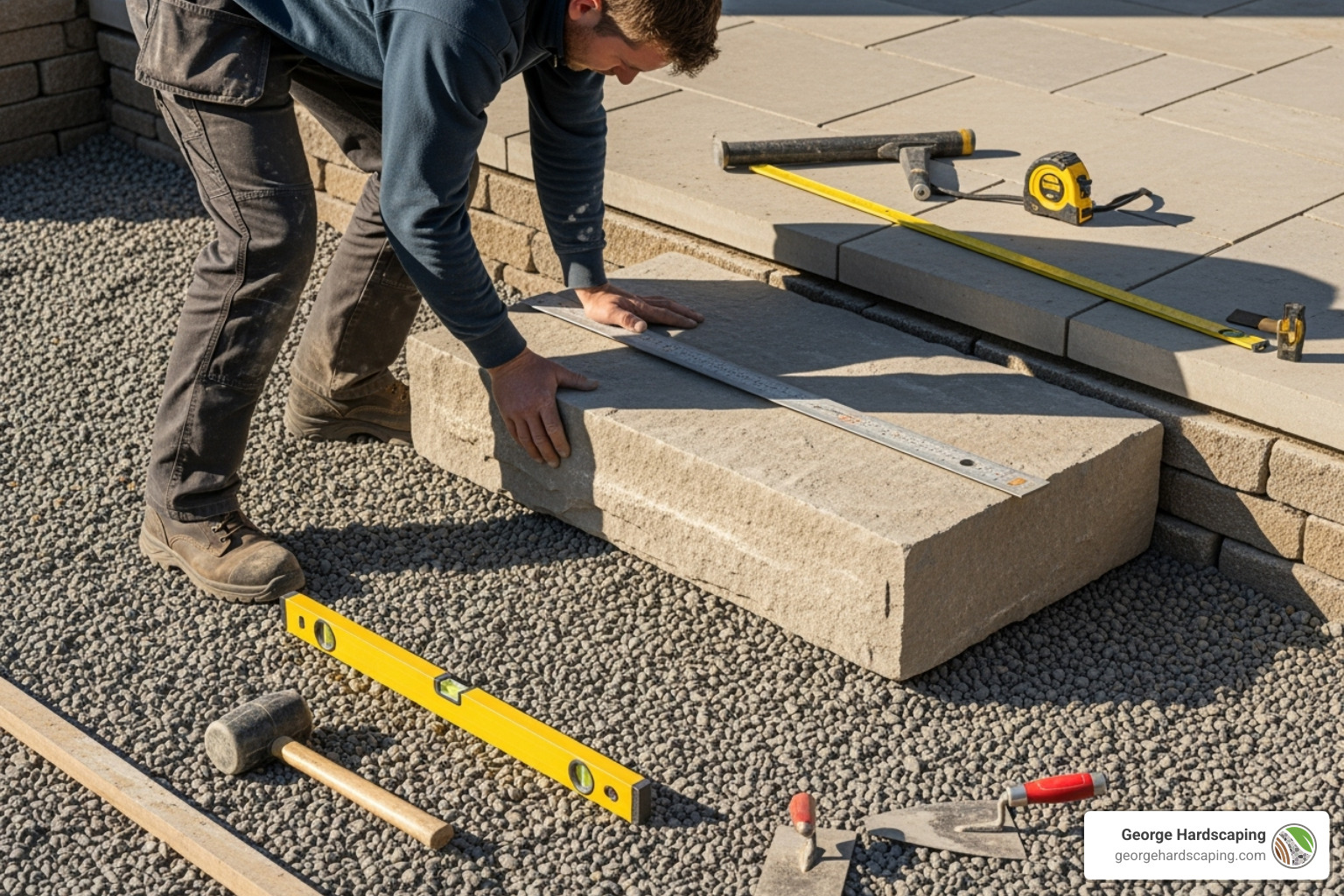
The invisible work that happens below ground is what ultimately determines whether your steps will remain level, stable, and safe for years to come. A professional installation process involves several critical, non-negotiable stages:
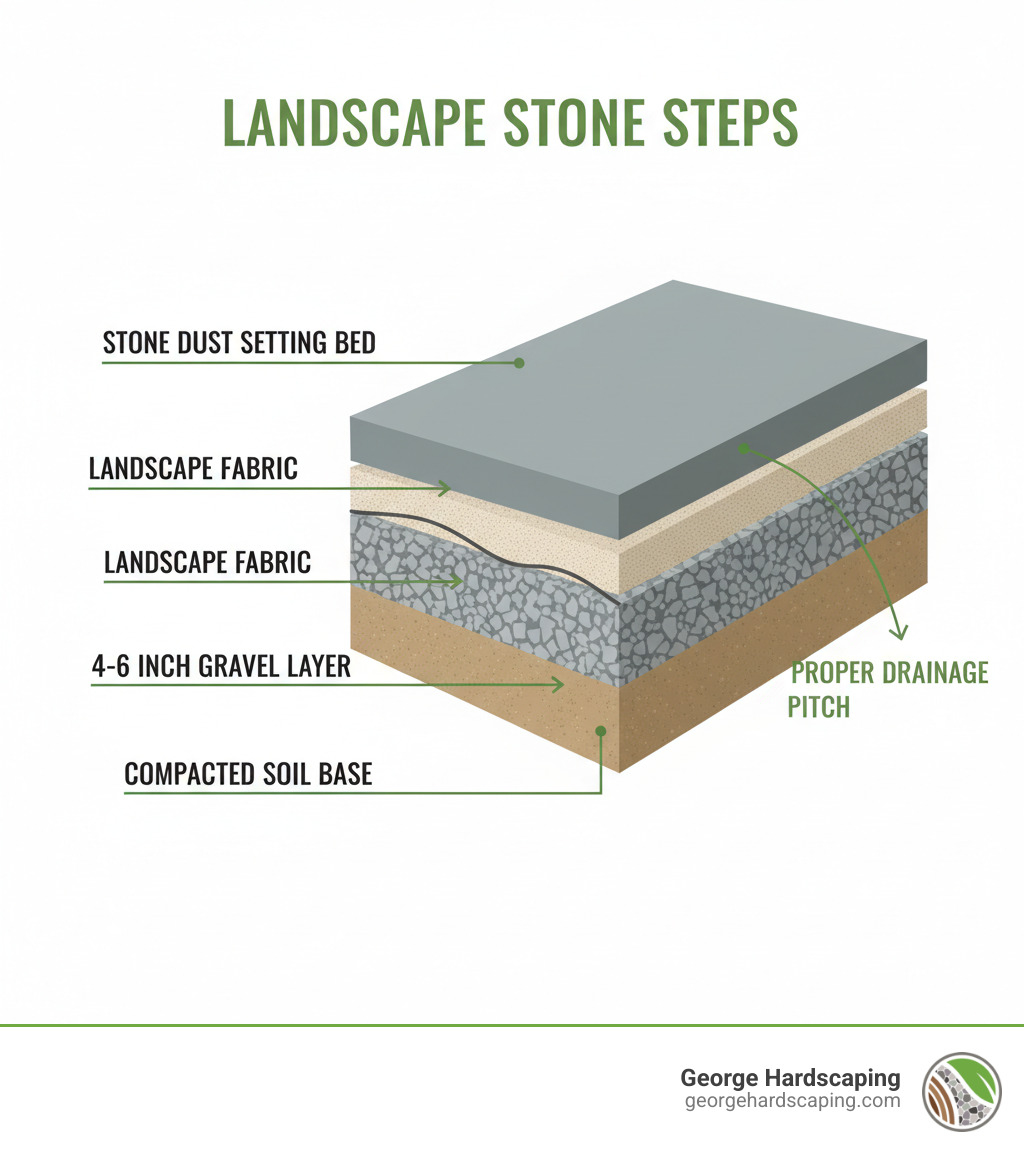
- Excavation and Grading: The process begins with carefully excavating the area to a depth of 6-8 inches below the finished height of the bottom step. The sub-grade is then meticulously graded to ensure water flows away from the steps and any nearby structures, like your home’s foundation.
- Compacted Aggregate Base: A 4- to 6-inch layer of 3/4-inch crushed stone (processed gravel) is laid down. This material is then compacted in lifts using a heavy-duty plate compactor. This step is the most crucial part of the entire process, as it creates a stable, load-bearing foundation that provides excellent drainage and resists the powerful upward force of frost heave during winter.
- Geotextile Fabric and Setting Bed: A layer of professional-grade landscape fabric is placed between the native soil and the gravel base. This prevents the gravel from sinking into the soil over time and stops weeds from growing through the joints. On top of the compacted gravel, a 1- to 2-inch layer of stone dust or coarse sand is placed and compacted to create a final setting bed.
- Calculating Rise and Run: Before setting the first stone, we carefully calculate the rise (height) and run (depth) of each step to ensure they are uniform, comfortable, and safe to navigate. A comfortable standard is typically a 6-7 inch riser height and a 12-14 inch tread depth.
- Setting, Leveling, and Pitching: Starting from the bottom step and working up, each massive stone is carefully set into place. We use levels to ensure each step is perfectly level from side to side, but also pitched slightly forward (about 1/4 inch per foot) to encourage water to run off the front and not pool on the surface.
- Jointing and Finishing: Once all the steps are set, the joints between them are carefully filled. Depending on the design, this can be done with polymeric sand, which hardens to lock the steps in place while remaining flexible, or with traditional mortar for a more rigid and formal look.
Proper drainage is especially critical on sloped installations to prevent water pressure and erosion from undermining the structure. In addition to pitching the treads, we may install perforated drainage pipes behind the steps to actively manage significant water flow. Our guide on how to install stone steps on a slope covers these advanced techniques, and technical guides like the Rosetta Dimensional Steps Installation Guide offer specifications professionals rely on.
Ensuring Longevity: Maintenance for Your Natural Stone Steps
While natural stone is famously low-maintenance, a few simple, seasonal practices will keep your steps looking beautiful and performing safely for a lifetime.
- Regular Cleaning: Sweep away leaves, dirt, and other organic debris regularly to prevent staining and the growth of slippery moss or algae. For a deeper clean, wash your steps at least twice a year with water and a pH-neutral stone cleaner. Avoid acidic or abrasive household chemicals, which can etch or discolor the stone.
- Protective Sealing: Applying a high-quality penetrating sealer is a wise protective measure. It soaks into the stone to repel moisture, oils, and other stains, and provides additional protection against freeze-thaw damage. We recommend reapplying a sealer every 2-3 years, especially for more porous stones. As noted in pro techniques from US Marble, this is a critical step in protecting your investment.
- Conscious Winter Care: Never use standard rock salt (sodium chloride) on natural stone, as it can cause pitting and deterioration. Instead, opt for calcium chloride-based ice melters, which are much safer for masonry. When shoveling, always use a plastic shovel to avoid scratching or chipping the stone surface.
- Annual Inspections: Each spring, take a few minutes to inspect your steps. Look for any signs of movement, check that the joints are still intact, and address any minor issues before they can become major problems. Catching a small amount of settled joint sand early is a simple fix that prevents future instability.
Frequently Asked Questions about Landscape Stone Steps
Over the years, we’ve heard many of the same excellent questions from homeowners who are considering an investment in landscape stone steps. To help you make informed and confident decisions for your property, we’ve compiled the answers to the most common inquiries.
What is the best base material for stone steps?
The absolute best base is a 4- to 6-inch layer of compacted 3/4-inch processed gravel or crushed stone. This specific material is crucial because the angular stones lock together when compacted, creating an incredibly firm, stable foundation. Unlike sand or pea gravel, it provides excellent drainage, allowing water to flow through rather than pooling and freezing, which is the primary cause of heaving and shifting in New England’s climate. We also insist on placing a high-quality geotextile fabric between the soil and the gravel base. This membrane prevents the gravel from mixing with the underlying soil over time, ensuring the base remains stable and maintenance-free for the long term.
How much do natural stone steps typically cost?
The cost of landscape stone steps varies widely based on four key factors: the type of stone selected, the size and weight of the individual steps, the complexity of the site (e.g., a steep slope vs. flat ground), and the associated professional labor. Material costs alone can range from around $85 per step for smaller, common options to $400 or more for large, premium slabs like antique reclaimed granite, based on internet averages (not George Hardscaping pricing).
Professional installation is a significant portion of the total cost, but it is a worthwhile investment in longevity and safety. It ensures the critical base preparation, precise leveling, and proper drainage are all handled correctly, preventing the steps from shifting, settling, or becoming a hazard. While a small DIY project might cost $500-$1,000 in materials, a professionally installed flight of steps can range from $2,500 to $7,500 or more, reflecting the skill, equipment, and expertise required to build a structure that will truly last a lifetime.
Can stone steps be installed on a steep slope?
Yes, absolutely. In fact, stone steps are the premier solution for making steep slopes safe, accessible, and beautiful. Installing steps on a slope is significantly more complex than on flat ground, as it requires careful excavation to ‘cut’ level tiers into the hillside for each step to rest on. The compacted gravel base is even more critical in this application to create a stable footing and prevent any downward shifting on the incline.
For very steep slopes, we often integrate the steps with flanking retaining walls to hold back the surrounding earth and create stable, terraced planting areas. Due to the complexity of ensuring proper drainage, a solid foundation, and long-term stability, professional expertise is highly recommended for any sloped installation. The result is a stunning, permanent feature that transforms challenging terrain into a safe and attractive pathway.
Are natural stone steps slippery when wet?
This is a valid concern, and the answer depends entirely on the stone’s finish. Polished or honed stones can be very slippery and are not recommended for outdoor steps. However, the finishes typically used for exterior applications, such as a natural cleft (common on bluestone), thermal (common on granite), or rock-faced, have a textured surface that provides excellent traction even in wet or icy conditions. Choosing the right finish is a key part of the design process to ensure your steps are as safe as they are beautiful.
Can a single damaged stone step be repaired?
Yes, in most cases, a single step can be repaired or replaced. If a step cracks or a corner chips, a skilled mason can often perform a repair using specialized epoxies and stone dust that can be blended to match the existing stone. If the damage is too severe, the individual step can be carefully removed and a new one set in its place. This is another advantage of stone over poured concrete, where a crack often necessitates patching that rarely matches or requires the replacement of the entire structure.
How do you ensure the steps meet building codes?
Safety and compliance are paramount. While codes can vary by town, professionals adhere to universal best practices for stair construction. This involves ensuring a consistent riser height (the vertical distance between steps) and tread depth (the horizontal surface you step on) for the entire flight. Inconsistent heights are a major tripping hazard. We build to a comfortable and safe standard, typically a 6-7 inch riser and a 12-14 inch tread, and ensure the structure is sound and stable, meeting or exceeding all local requirements.
Conclusion: A Lasting Investment in Beauty and Function
When you choose to install landscape stone steps, you are making a powerful and permanent decision that transforms your property for generations. These are not temporary fixes or high-maintenance additions; they are foundational features that artfully weave together the different levels of your landscape with timeless beauty and rock-solid reliability. From a once-difficult slope that becomes an inviting garden path, to a plain front entrance that gains stunning curb appeal and gravitas, the right stone steps elevate your entire outdoor living experience, adding value that extends far beyond the monetary.
For homeowners in Essex County and across the North Shore, selecting materials that can withstand our region’s demanding weather is not optional—it’s essential. Landscape stone steps confidently meet this challenge, resisting the relentless freeze-thaw cycles, heavy rains, and summer sun that degrade and destroy lesser materials. When installed by experts upon a meticulously prepared foundation, they become a lasting and integral part of your home’s story, a feature that will be enjoyed by your family for decades to come.
At George Hardscaping, we merge technical precision with artistic vision. We understand the science behind preparing a base that won’t shift, the art of selecting stones that perfectly complement your home’s architecture, and the nuance of creating transitions that feel both natural and intentional. Our unwavering commitment to superior craftsmanship ensures that your investment not only enhances the beauty and safety of your property but also adds significant, lasting value.
Ready to transform your landscape and bring your vision to life? Contact us today for a professional stone step installation estimate!
Don’t wait another season to improve your home’s curb appeal and functionality. Request your consultation now and let George Hardscaping craft the beautiful, durable landscape stone steps your property deserves!
