
Decomposed Granite Walkway Installation: 1 Easy Guide
Why Choose a Decomposed Granite Walkway?
Decomposed granite walkway installation creates one of the most natural and cost-effective paths for your property. For North Shore homeowners looking to improve their landscape, decomposed granite (DG) delivers a unique combination of beauty and function. This naturally weathered material forms a surface that looks organic and blends with plantings while still providing the durability needed for everyday foot traffic.
Beyond its practical benefits, DG offers significant aesthetic flexibility. Available in a warm palette of colors—from golden tans and subtle grays to rich browns—it can be selected to complement any architectural style, from a classic New England colonial to a sleek, modern home. The fine, sandy texture creates a softer, more inviting appearance than rigid pavers or stark concrete can achieve.
What sets DG apart is how it balances performance, aesthetics, and sustainability. Unlike concrete or mortared stone, DG is permeable. Rainwater can soak through the surface and filter into your soil, replenishing groundwater and reducing stormwater runoff. That permeability supports healthier landscapes and helps mitigate puddling and erosion. If you want to understand why permeable surfaces matter in residential design, you can review the U.S. Environmental Protection Agency’s overview of permeable pavements. As a natural material, it also has a lower embodied energy than many manufactured paving products.
Durability is another major advantage. When installed correctly—over a compacted base, with edging, and in thin, moistened lifts—DG compacts into a firm, comfortable walking surface. It works beautifully for front entries, side-yard connectors, and winding garden trails. While loose DG has a softer, natural feel underfoot, stabilized DG adds binders for extra strength on slopes and in high-traffic areas.
From a cost perspective, DG offers excellent value. Based on general market research, professional installation often averages about $4–$6 per square foot for pedestrian walkways, depending on site access, soil conditions, edging choice, and whether you select natural or stabilized DG. These are typical market ranges and not specific George Hardscaping prices. DIY material costs are comparatively low, with raw DG commonly running around $40–$50 per cubic yard, plus base gravel, edging, and equipment rentals.
Advantages at a glance:
- Visual warmth that complements both traditional and modern homes
- Design flexibility for straight or curved layouts
- Permeability that supports responsible stormwater management
- Lower installed cost than many hard surfaces
- Serviceable, low-maintenance performance when installed correctly
A quick overview of the installation process:
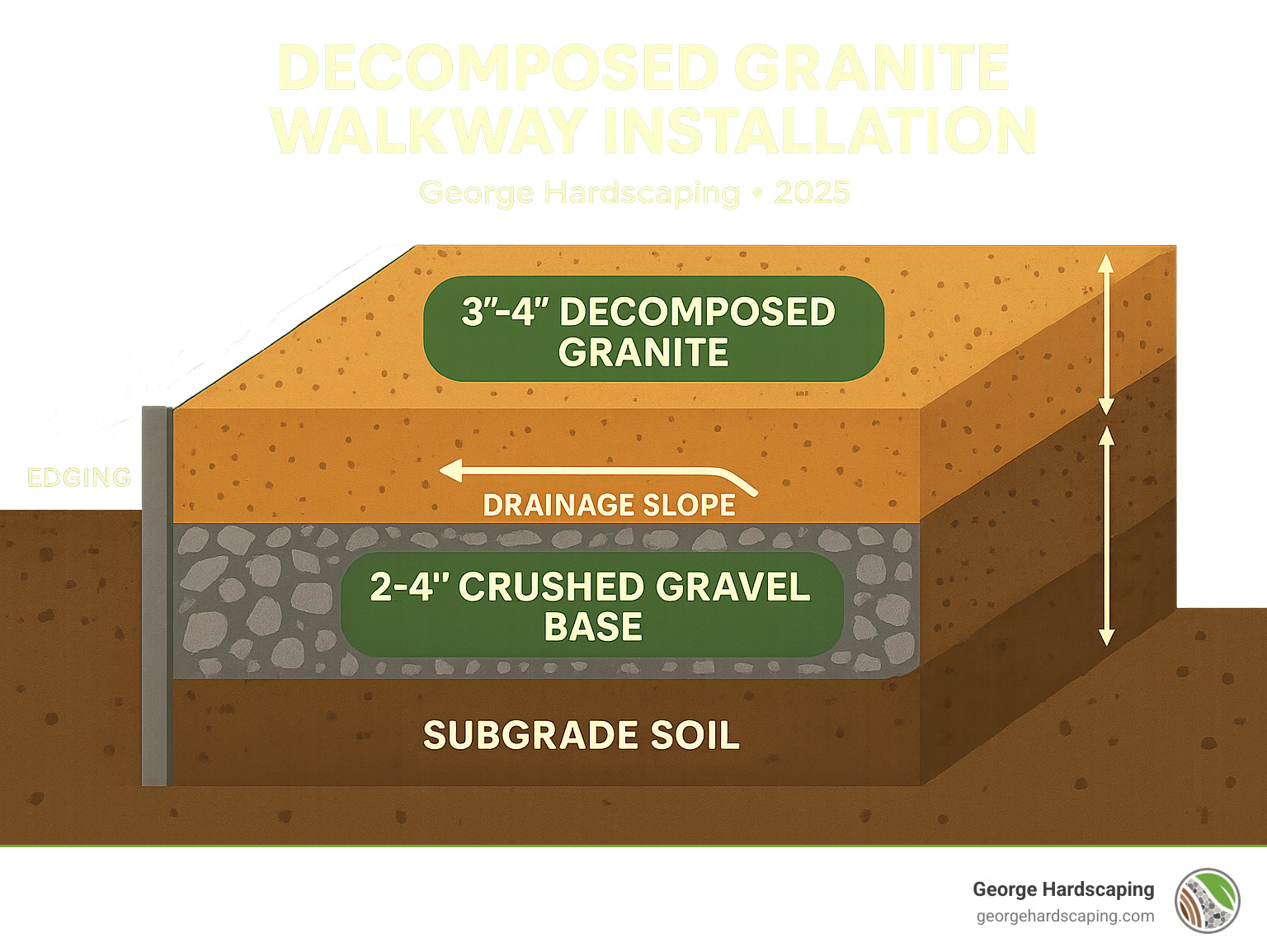
- Excavate the area 5–8 inches deep to accommodate base and DG layers.
- Install edging to contain the materials and maintain clean lines.
- Add a compacted base of crushed gravel (2–4 inches for pedestrian use).
- Mist and compact the base thoroughly.
- Apply DG in 1–2 inch lifts, lightly mist, and compact each lift.
- Repeat until you reach a 3–4 inch total DG depth.
- Finish with a smooth, even surface and a final light compaction.
DG’s natural compaction suppresses weeds, needs minimal upkeep, and can be touched up easily in future seasons. It is especially popular for New England landscapes because it looks at home next to granite steps, fieldstone walls, and plant-forward garden designs. If you plan to integrate your walkway with additional features—such as a patio, steps, or edging—George Hardscaping can design those elements together for a cohesive look. Explore how we combine walkways with larger projects on our service overview: hardscaping and masonry services.
If you prefer to compare surface options before finalizing your walkway plan, DG is an ideal middle ground between loose gravel and rigid pavements like pavers or concrete. It stays in place better than pea gravel, offers a softer, more natural aesthetic than concrete, and can adapt to curves and grade changes with fewer cuts and joints than stone or pavers. For design inspiration across different materials, browse our work: project gallery.
Planning Your Project: Materials, Tools, and Design
Successful decomposed granite walkway installation begins with thorough planning. A clear layout, correct material specifications, and the right tools will save time on site and ensure a professional result.
Essential Tools and Materials for Decomposed Granite Walkway Installation
It’s possible to install a small path with hand tools, but proper equipment makes a noticeable difference in finish quality and long-term performance.
- Digging and shaping: A round-point shovel for excavation, a flat shovel for shaping, and a heavy-duty landscaping rake for grading and spreading.
- Hauling: A sturdy, well-balanced wheelbarrow (two-wheeled models add stability on uneven ground).
- Compaction: A hand tamper can work for very small areas, but for anything beyond a narrow garden path, a plate compactor rental is strongly recommended. Proper compaction is critical to long-term durability.
- Weed barrier: High-quality, non-woven geotextile landscape fabric reduces weeds and keeps your base and DG layers separated from native soils. For detailed guidance on fabric selection and proper usage, the University of Minnesota Extension’s overview on landscape fabric is an excellent resource.
- Edging: Steel edging for sleek durability; stone or brick for a classic border; pressure-treated or rot-resistant hardwood for a rustic edge; or high-quality composite/plastic edging for budget projects. Your edging should be anchored and set to the correct finished height.
- Base material: Crushed gravel, road base, or Class II base with fines that lock up under compaction. Angular aggregates compact and interlock better than rounded pea gravel.
- Water and measurement: A hose with a misting nozzle, a string line, a long straightedge (or 2×4), stakes, a level, and a tape measure to verify slopes and depths.
- Layout and prep: Use marking paint or a combination of string lines and stakes to outline the path. For turf removal, a rented sod cutter can accelerate the job and leave clean edges.
- Safety: Gloves, eye protection, hearing protection for the plate compactor, dust mask/respirator when handling dry materials.
For hardscaping beyond walkways—including steps, patios, and stonework—George Hardscaping offers integrated design and build services that align finishes, edges, and elevations across spaces. Explore what’s possible: hardscaping and masonry services.
Choosing the Right Type of Decomposed Granite
Not all DG is identical. The choice between natural (loose), stabilized, and resin-coated blends impacts budget, maintenance, and performance.
- Natural (loose) DG: The most economical and natural-looking. It compacts to a firm surface but remains slightly looser on top, giving it that characteristic soft crunch. Best for flat or gently sloping paths with moderate foot traffic, like secondary garden paths or seating areas.
- Stabilized DG: Natural DG blended with binders that activate with water and compaction to create a firmer, more cohesive surface. This is the ideal choice for heavier foot traffic zones, moderate slopes, or areas where wheelchair or stroller friendliness is desired. The binders significantly improve erosion resistance and reduce tracking.
- Resin-coated DG: The most durable and pavement-like. DG aggregate is coated in a clear resin, creating a fully bound, non-eroding surface that is highly permeable. It resists erosion and tracking, performs well on slopes, and offers minimal ongoing maintenance. It is also the most expensive and has a less “soft” look and feel than loose or stabilized DG.
When sourcing your material, be sure to ask the supplier about its gradation. A well-graded DG with a balanced mix of fine dust and small 1/4-inch aggregate will compact far better than a uniform material. If possible, get a sample and inquire if a large order will come from a single batch to ensure color consistency. Within each category, color and gradation vary. Golds, tans, browns, and grays are common; select a hue that harmonizes with your home’s trim and adjacent masonry.
Designing Your Walkway and Calculating Materials
DG lets you design sinuous, organic paths without the joint complexity of pavers or the cutting required by rigid stone. Keep function first and aesthetics close behind.
- Sketch your concept: Main walkways to doors should be 4–5 feet wide for comfortable two-person passing; secondary paths can be 2–3 feet. For cart access (trash/recycling), consider a minimum of 3 feet.
- Walk the route: Mark the edges with paint or string and test the walk multiple times. Pinch or expand curves until the route feels natural and clears plantings by at least a few inches for seasonal growth.
- Slope for drainage: Target a subtle 1–2% slope (about 1/8–1/4 inch of fall per foot) away from structures to prevent ponding. For a deeper understanding of why permeable surfaces and thoughtful grading are critical for sustainable landscaping, refer to the EPA’s guidance on permeable pavements.
- Depth planning: For pedestrian paths, plan 2–4 inches of compacted base and 3–4 inches of compacted DG. In freeze-thaw regions like the North Shore, the base provides stability through seasonal movement.
- Material calculations: Convert depth to feet; then use (square footage × depth in feet) ÷ 27 = cubic yards. Always order 10–15% extra to account for compaction and minor grading adjustments.
Illustrative example: A 60-foot-long, 3-foot-wide garden path equals 180 square feet. With a 3-inch base (0.25 feet) and a 3-inch DG layer (0.25 feet), you’ll need roughly 1.67 cubic yards of base and 1.67 cubic yards of DG. Add 10–15% to each number to cover compaction and edge feathering.
Integrating with Other Hardscape Features
DG paths pair beautifully with stone steps, brick accents, and patios. You can border a DG path with brick or granite cobbles for a refined look, or drop in stepping stones within DG to create rhythm and visual interest. If your project includes steps or transitions, see how we approach safe, attractive risers: custom steps and brick stairs. For outdoor living areas that connect seamlessly to DG walkways, review options here: patio design and installation.
Ready to move from planning to action? Get pricing clarity, timeline expectations, and site-specific expert guidance. Get a fast, no-obligation quote now: Request your free estimate.
The Complete Decomposed Granite Walkway Installation Process
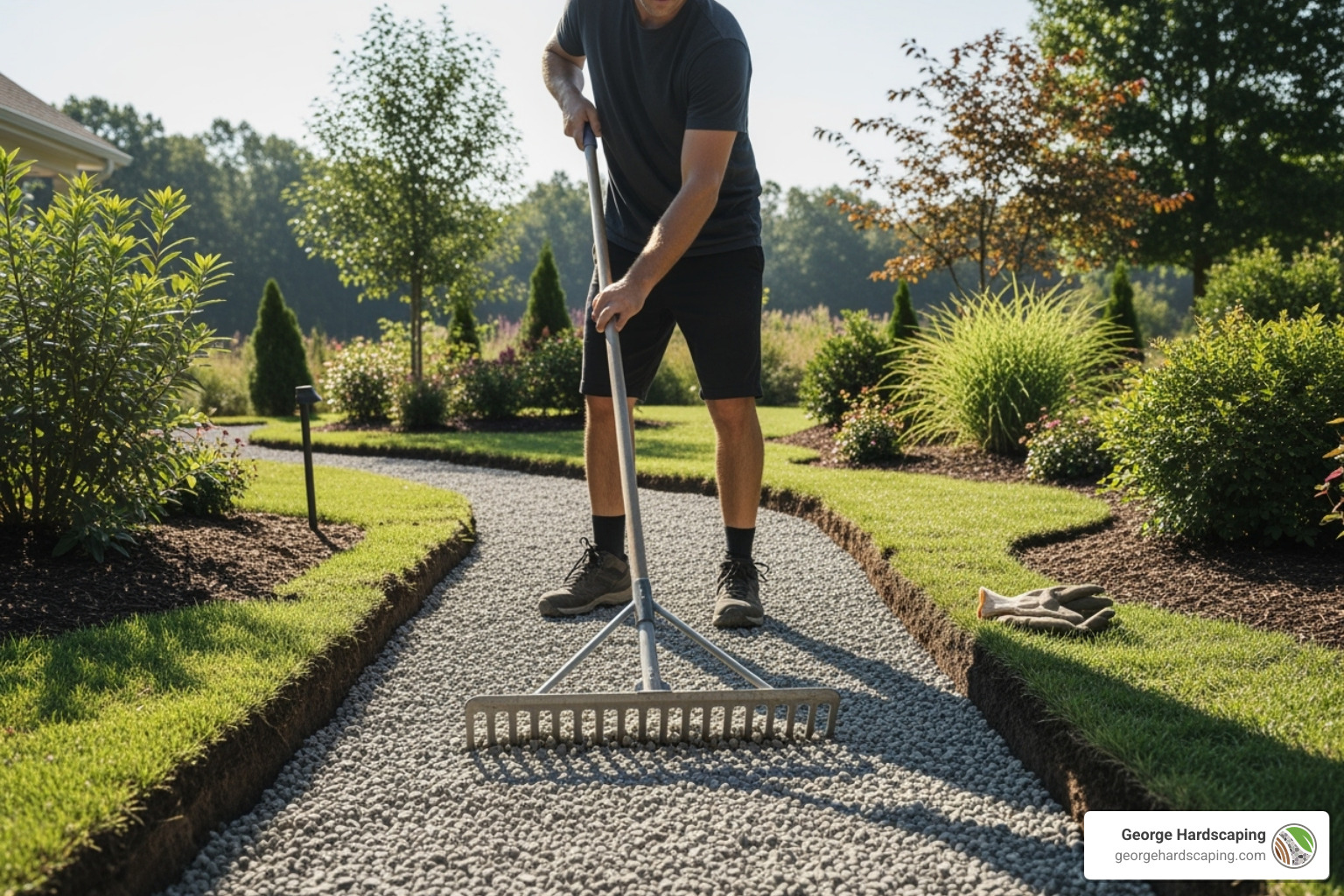
A durable DG walkway comes from strict attention to site prep, separation, compaction, and moisture control. Rushing any step typically leads to ruts, soft spots, or erosion. The outline below reflects best practices for pedestrian paths in New England climates.
Step 1: Excavation and Ground Preparation
Clear the path area of vegetation, roots, and organics. A sod cutter speeds turf removal and yields clean edges. Excavate to a total depth of 5–8 inches for pedestrian walkways, allowing room for both the compacted base (2–4 inches) and compacted DG (3–4 inches). Depth choice depends on soil strength, drainage, and desired finished thickness.
Shape the subgrade to a consistent elevation and introduce a 1–2% slope to encourage drainage. In areas adjacent to buildings, grade away from foundations to reduce moisture issues. Remove any large rocks or roots that could telegraph through or cause future settlement.
Compact the subgrade using a plate compactor (or a hand tamper for very small areas). The goal is a firm, unyielding surface. Multiple overlapping passes help achieve uniform density. If the subgrade is very dry and dusty, a light mist of water can reduce dust and slightly improve compaction. If it’s saturated, postpone work until the soil firms up. Proper subgrade firmness prevents the entire assembly from sinking and keeps your final surface smooth.
Step 2: Installing Edging and Landscape Fabric
Edging is essential for containing DG and maintaining crisp borders. Common options include:
- Steel edging for a clean, modern line and strong containment
- Brick or stone edging for a classic aesthetic
- Pressure-treated or rot-resistant hardwood for rustic edges
- High-quality composite or plastic edging for cost-conscious projects
Set edging to the correct finished height, leaving a lip of roughly 1/2–1 inch above the planned DG surface to keep material in place. Anchor per the manufacturer’s instructions, and backfill and tamp the outside edge soil for stability.
Install a high-quality, non-woven geotextile landscape fabric across the excavated area before placing base material. Overlap seams 6–12 inches and pin with landscape staples. The fabric’s primary role is separation—preventing your base from mixing with the native soil—while also suppressing weeds. For more in-depth selection considerations and a breakdown of benefits, you can review this guidance on landscape fabric from the University of Minnesota Extension.
Step 3: Building a Solid Base
A well-graded, well-compacted base is the backbone of a long-lasting DG path. Use crushed gravel, road base, or Class II base with a range of particle sizes and fines. The sharp, angular nature of the stones is critical, as they lock together under compaction (a principle called mechanical interlock) to form a stable layer. Avoid rounded aggregates (like pea gravel) as they don’t interlock and can shift underfoot.
Place the base material in 2–3 inch lifts, raking each lift to an even thickness. Lightly moisten until the material is damp—not muddy. Compact with a plate compactor in multiple overlapping passes. The base is ready when the compactor leaves little to no footprint.
Depth guidelines for pedestrians typically range from 2–4 inches of compacted base. If you anticipate hand truck loads, delivery carts, or frequent heavy foot traffic, lean toward the deeper end of the range. In freeze–thaw climates, the base helps buffer seasonal movements and preserves surface integrity.
Pro tip: If you’re aiming for an extremely firm installation or working with marginal soils, you may consider a geotextile fabric rated for separation and reinforcement beneath the base. While not mandatory for most garden paths, it can add stability in soft areas.
Step 4: Laying, Watering, and Compacting the DG
Spread DG in thin 1–2 inch lifts. Rake each lift to an even surface, lightly mist to dampen, and compact immediately. Spreading the material too thick is a common failure point, as it prevents the compactor from densifying the material at the bottom of the lift. Repeat across the path until you reach a final compacted depth of 3–4 inches for pedestrian use.
Moisture control matters. The material should be evenly damp, similar to the feel of sandcastle sand. A good field test is to squeeze a handful; it should clump together but not drip water. Too dry and the fines won’t bind; too wet and the surface can pump and smear. For stabilized DG, follow the product’s specific instructions for water activation and curing. Curing often requires 24–48 hours with light, periodic misting so binders set uniformly.
Compaction quality is the biggest differentiator between a walkway that performs for years and one that develops soft spots. While you won’t be running laboratory tests on a home project, the goal mirrors industry principles described in soil compaction standards like ASTM D1557 (Modified Proctor)—achieving a dense, stable structure by placing and compaction in controlled lifts.
Step 5: Quality Control, Detailing, and Cleanup
After final compaction, use a straightedge or 2×4 to strike off the surface and reveal any high or low areas. Correct small lows with a bit more DG, mist, and tamp. Check edges and transitions to ensure the DG surface sits slightly below the edging lip for containment.
Sweep or lightly blow off loose particles so the finished surface is even and clean. Avoid heavy water streams immediately after install; a gentle mist is sufficient during the first day if you used stabilized DG.
To see how these steps come together across a range of site conditions, view examples in our project gallery.
Finishing Touches, Maintenance, and Advanced Tips
With the heavy lifting complete, final detailing and a simple maintenance plan will keep your DG walkway looking and performing its best for years.
Achieving a Professional Finish and Long-Term Maintenance
- Final leveling: Drag a straight 2×4 across the surface to knock down highs and reveal lows. Make small top-up corrections as needed, then give a final light compaction pass.
- Weed control: Quality landscape fabric plus a dense, compacted surface keeps most weeds at bay. Any occasional volunteers can be pulled by hand.
- Cleaning: Use a leaf blower on low or a stiff broom to remove leaves and debris. Avoid pressure washing, which can dislodge fines.
- Refreshing: Every few years, add a thin top dressing of DG, mist, and tamp to revive color and smoothness. Stabilized DG may need less frequent refreshes.
- High-traffic tune-ups: For entrances or narrow sections, periodic hand-tamping keeps the surface tight and comfortable underfoot.
New England Weather Considerations
- Freeze–thaw cycles: A compacted base and proper drainage are your best defenses against winter movement. Avoid installing when subgrade is saturated or frozen.
- Snow and ice: Use plastic shovel edges rather than metal to avoid gouging. If de-icing is required, avoid sodium chloride (rock salt), which can damage the surface and harm plants. Instead, apply sand for traction or use a less corrosive de-icer like calcium magnesium acetate (CMA) sparingly.
- Heavy rains: Well-compacted DG with edging resists washouts. For sloped sections, consider stabilized DG for improved cohesion.
Integrating Your Walkway with Plantings
A DG path is a living part of the garden, and its permeability benefits adjacent plantings. When selecting border plants, choose species that appreciate good drainage and won’t have aggressive roots that could heave the edging. Drought-tolerant perennials like lavender, sedum, catmint, and ornamental grasses are excellent choices that soften the path’s edges and thrive in the conditions DG helps create.
Accessibility, Slopes, and Edges
Where accessibility is a goal, keep cross slopes gentle (generally 2% max is a common guideline for accessible routes) and surfaces firm and stable. The U.S. Access Board’s ADA guidance on ground and floor surfaces discusses these considerations and cross-slope limits for accessible routes—helpful context when planning inclusive walkways.
Maximum practical slopes for loose DG are modest; stabilized DG performs better on grades. On steeper segments, add resting flats or switchbacks to improve traction and comfort. Use sturdy edging to contain material along curves and slopes.
Common Mistakes in Decomposed Granite Walkway Installation
- Inadequate base prep: Thin or uneven base layers lead to settlement. Invest time in grading and compacting the base.
- Poor compaction: Skipping the plate compactor or laying DG too thick creates soft, ravel-prone surfaces.
- Incorrect depth: Less than 3 inches of compacted DG is prone to rutting; layering is key.
- Skipping edging: Uncontained edges fray into lawns and beds, creating constant cleanup.
- Over-watering: Soggy DG pumps under the compactor and won’t lock. Aim for uniformly damp, not wet.
- Wrong DG type: Loose DG on steep slopes or in high-traffic entries will require frequent touch-ups; choose stabilized blends for those conditions.
DG also pairs nicely with other materials. Consider a DG path that lands on a stone stoop or ties into a patio to give your landscape a cohesive flow. For ideas, browse our patio design and installation options or explore how we build durable custom steps and brick stairs.
Frequently Asked Questions about DG Walkways
Homeowners often ask similar questions before starting a decomposed granite walkway installation. Here are practical, field-tested answers and references to help you plan with confidence.
How do you keep decomposed granite from washing away?
Erosion resistance comes from the entire assembly, not one element:
- A solid compacted base (2–4 inches for pedestrians) provides stability and drainage.
- Proper edging contains the surface at the margins.
- DG placed in thin, moistened lifts and compacted thoroughly locks fines in place.
- On slopes or high-traffic routes, stabilized DG with binders adds cohesion.
- On steeper grades, consider installing subtle water bars or a parallel French drain to intercept runoff.
Is landscape fabric necessary under decomposed granite?
While not strictly mandatory, we strongly recommend high-quality, non-woven geotextile fabric. It reduces weed pressure and, more importantly, keeps your base and DG separate from native soils, which is critical for long-term performance and drainage. For selection tips and benefits, you can consult this University Extension resource on landscape fabric.
Can you put decomposed granite over dirt?
No. Installing DG directly over dirt typically leads to uneven settlement, mud during wet periods, and rapid weed intrusion. Proper excavation, separation with fabric, and a compacted base are essential. If you’re curious how compaction principles support stable surfaces more broadly, industry guidance such as ASTM D1557 outlines standards for achieving durable compaction (for reference; not a DIY requirement).
How thick should a DG walkway be?
For pedestrian use, plan a compacted DG surface of 3–4 inches over a 2–4 inch compacted base. In freeze–thaw regions or on routes with hand truck traffic, favor the thicker end of these ranges. Build in layers and compact each lift.
What type of DG is best for a sloped path?
Stabilized DG is the safer choice on slopes. Its binders help resist erosion and tracking. Keep slopes modest, add switchbacks where appropriate, and ensure strong edging.
Does DG track into the house?
Loose DG can track slightly, especially in the topmost fines. You can minimize tracking by using stabilized DG in high-traffic entry zones, maintaining firm compaction, and incorporating a boot brush or dual-mat system at doors. Designing the last few feet of a path with embedded stepping stones also helps knock particles from shoes.
Is DG permeable and environmentally friendly?
Yes, DG is considered permeable and can be part of sustainable stormwater design by promoting infiltration and reducing runoff. The EPA’s Soak Up the Rain program has a helpful overview of permeable pavements and their environmental benefits.
Is DG wheelchair or stroller friendly?
A well-compacted stabilized DG surface is much more accommodating than loose gravel; however, the firmest, most consistent results come from careful installation, adequate depth, and moisture-controlled compaction. Mind cross-slope and transitions for comfortable rolling. For broader context on accessible surfaces, consult the U.S. Access Board’s guidance on floor and ground surfaces.
How do I maintain a DG path through winter?
Use plastic-edged snow shovels and remove snow before it compacts. Avoid aggressive scraping near edges. For ice, use traction grit or minimal de-icer to protect nearby plantings and surfaces. In spring, sweep, top up minor lows with a thin DG layer, mist, and tamp.
Can I set stepping stones or pavers into DG?
Yes. Many homeowners set large-format stone or brick in a compacted DG bed for visual variety. The key is to excavate a spot for the stone within the compacted base layer so its top surface sits perfectly flush with the final DG grade. Set the stone on a thin layer of sand for leveling, then compact the DG around it.
What if I encounter soft, muddy soil during excavation?
Excavate to firm subgrade; consider a separation geotextile and increase base thickness to bridge soft spots. Compact in controlled lifts. For general unpaved-surface design and maintenance principles that illustrate the role of drainage and base quality (in a roadway context), the U.S. Forest Service’s Gravel Roads Maintenance and Design Manual offers useful background.
If you want a deeper dive into installation techniques and how they apply to other stone surfaces, you may also find these articles helpful:
- Practical prep concepts overlap with our guides on base for flagstone walkway
- Step-by-step methods in how to install stone walkway
- Budget planning in cost to install stone walkway
For professional-grade DG paths used in public landscapes, the results often come from rigorous detailing and stabilization. Explore award-winning landscape projects here: ASLA Professional Awards.
Get Your Perfect Walkway with Professional Installation
Creating a stunning decomposed granite walkway can transform any landscape with natural beauty and long-term performance. While DG is DIY-friendly in small areas, a polished, durable installation—especially on larger sites, slopes, or heavy-use routes—benefits from professional-grade equipment and experience.
At George Hardscaping, we handle the entire process: site evaluation and grading strategy, excavation, fabric installation, base selection and compaction, DG type and color matching, lift-by-lift compaction, edging, drainage detailing, and final finishing. We tailor each walkway to New England soils and weather, and we can integrate the path with steps, patios, and planting borders for a cohesive landscape. See the breadth of what we build: hardscaping and masonry services, and explore finished work in our project gallery.
We serve the North Shore, including:
- Beverly
- Boxford
- Danvers
- Essex
- Georgetown
- Gloucester
- Ipswich
- Lynnfield
- Manchester-by-the-Sea
- Marblehead
- Newburyport
- North Reading
- Peabody
- Rockport
- Rowley
- Salem
- Swampscott
- Topsfield
- Wenham
Strong CTA: Ready to upgrade your landscape with a durable, beautiful DG walkway? Get a fast, no-obligation quote today: Request your free estimate.
If your project also includes a new gathering space, we can design and build the connecting patio to match your walkway’s tone and texture: patio design and installation. Strong CTA: Prefer to skip the heavy lifting and guarantee a professional finish? Let our team manage every detail—from excavation to final compaction. Start now: Request your free estimate.
