
Cost to Install Stone Walkway: Save Big 2025
Why Understanding Stone Walkway Costs Matters for Your Home Investment
The cost to install stone walkway can vary significantly, but homeowners can generally expect to pay between $16-$35 per square foot for professional installation. Total project costs often range from $1,600 for a basic 100-square-foot path to over $10,000 for projects using premium materials and complex designs.
Quick Cost Breakdown:
- Materials only: $7-$18 per square foot
- Labor and installation: $9-$17 per square foot
- Total installed cost: $16-$35 per square foot
- Typical 5’x20′ walkway: $1,600-$3,500
- Premium projects: $4,500-$12,000+
A well-designed stone walkway is more than a path; it’s the first impression your home makes, boosting curb appeal and property value. For homeowners in Essex County and the North Shore of Massachusetts, stone is an ideal choice. It withstands harsh New England winters, provides excellent traction, and complements the region’s traditional architecture.
The investment is sound for several reasons. Stone walkways can last from 20 to 100 years, with granite and slate offering the longest lifespans. Unlike concrete, which cracks under freeze-thaw cycles, a properly installed stone walkway flexes with ground movement, ensuring fewer repairs and better long-term value. With a wide variety of natural stones available, from classic bluestone to warm sandstone, you can find a material that perfectly matches your home’s style and budget. Understanding these costs upfront helps you make an informed decision for the best return on your investment.
Understanding the Average Cost to Install Stone Walkway
When planning a stone walkway, the cost to install stone walkway projects typically ranges from $16 to $35 per square foot for professional installation. Prices can be as low as $8 per square foot for simple DIY projects or exceed $50 per square foot for premium, intricate designs. These are average costs based on internet data, and every project is unique. Our team provides personalized estimates after a site evaluation.
A standard 5-foot by 20-foot (100 sq. ft.) walkway generally costs between $1,600 and $3,500 installed. High-end projects with premium materials, curves, or extensive site prep can climb to $4,500-$12,000. Large, complex projects incorporating seating or multiple levels can range from $15,000 to $45,000, reflecting the vast possibilities with natural stone. As noted in Project Spending Data from Harvard University, outdoor improvements are a significant homeowner investment due to their lasting value.
The wide range in pricing reflects several variables that homeowners should understand before beginning their project. Regional labor costs, material availability, and local building codes all play significant roles in determining final costs. In Massachusetts, for example, the combination of skilled craftsmen and harsh winter conditions requires specific installation techniques that may increase initial costs but provide superior long-term performance.
Seasonal timing also affects pricing. Spring and fall are peak seasons for hardscaping projects, which can drive up labor costs due to high demand. Winter installations, while possible in mild weather, may require additional precautions and materials. Summer projects often offer the best balance of weather conditions and contractor availability, potentially resulting in more competitive pricing.
How Different Stone Types Affect the Cost to Install Stone Walkway
Your choice of stone is a primary driver of the cost to install stone walkway. Each type has a unique look, durability, and price point, making it essential to understand the characteristics of each option.
Bluestone is a classic New England choice, with a beautiful gray-blue hue that handles harsh winters well. This sedimentary rock is quarried primarily in Pennsylvania and New York, making it readily available in Massachusetts. Its natural slip resistance and ability to withstand freeze-thaw cycles make it ideal for our climate, with its properties as a feldspathic sandstone well-documented by sources like the U.S. Geological Survey. Installed, it costs $13 to $30 per square foot. The stone develops a beautiful patina over time, and its uniform thickness makes installation more straightforward than irregular stones.
Granite is a premium, incredibly hard option that can outlast your house. This igneous rock is quarried throughout New England, including right here in Massachusetts. Granite’s density makes it virtually impervious to weather damage, staining, and wear. Granite cobblestone walkways cost $18 to $50 per square foot installed. While more expensive initially, granite requires minimal maintenance and can handle heavy foot traffic without showing wear patterns.
Slate offers rich earth tones and a unique layered texture for high visual interest. Vermont slate is particularly prized for its quality and color consistency, a reputation backed by state geological resources like the Vermont Geological Survey. The natural cleft surface provides excellent traction, even when wet. Slate installations typically run $15 to $40 per square foot. However, slate can be prone to flaking in extreme weather conditions, and some varieties may fade over time when exposed to direct sunlight.
Sandstone provides warmth with its honey and rust tones. This sedimentary rock is softer than granite or slate, making it easier to cut and shape for custom designs. It’s more affordable at $11 to $30 per square foot installed, but it requires more maintenance. Sandstone is more porous than other options, making it susceptible to staining and requiring regular sealing. In freeze-thaw climates, proper installation and maintenance are crucial for longevity.
Limestone delivers timeless elegance with soft grays and creams. This sedimentary rock has been used in construction for centuries and offers a sophisticated appearance. It is comparable to bluestone, with installation costs from $13 to $30 per square foot. Limestone is naturally slip-resistant and develops an attractive weathered appearance over time. However, it can be affected by acid rain and requires periodic sealing in harsh climates.
Flagstone is a category of large, flat stones like slate or bluestone. The term refers to the shape and size rather than the specific rock type. Dry-set installation (on a gravel and sand base) costs $10 to $25 per square foot, while wet-set (mortared to concrete) is more expensive at $20 to $40 per square foot. Flagstone’s irregular shapes create a natural, organic appearance that complements landscape designs beautifully.
Cobblestone, often made from granite, creates a charming, old-world look. These durable stones cost $18 to $50 per square foot installed. Traditional cobblestones are reclaimed from old streets, while new cobblestones are cut to similar dimensions. The installation is labor-intensive due to the individual placement of each stone, but the result is a distinctive, historic appearance that adds significant character to any property.
| Stone Type | Average Cost per Sq. Ft. (Installed) | Durability | Maintenance Needs | Best Use Cases |
|---|---|---|---|---|
| Bluestone | $13 – $30 | High | Low to Moderate | Main walkways, pool areas |
| Granite | $18 – $50 | Very High | Low | High-traffic areas, formal settings |
| Slate | $15 – $40 | High | Low to Moderate | Artistic designs, natural settings |
| Sandstone | $11 – $30 | Moderate | Moderate to High | Warm climates, decorative paths |
| Limestone | $13 – $30 | Moderate | Moderate | Traditional homes, garden paths |
| Flagstone | $10 – $40 (varies by type/install) | High | Low to Moderate | Casual walkways, natural landscapes |
| Cobblestone | $18 – $50 | Very High | Low | Historic homes, driveways, courtyards |
We work with all these natural stone options and can help you select the best material for your specific needs, climate, and budget. Explore our Natural Stone Pavers options to see the possibilities.
Labor Costs and Installation Method
Skilled labor is a significant part of your investment, with professional hardscapers charging $50 to $100 per hour in the Massachusetts market. The installation portion of your project will typically cost $9 to $17 per square foot, depending on the complexity of the work and local labor rates.
The installation method also affects the final cost and long-term performance of your walkway.
Dry-laid installation involves setting stones on a compacted gravel and sand base. This method is less expensive and handles New England’s freeze-thaw cycles exceptionally well. The flexible base allows for natural ground movement without cracking, and individual stones can be easily replaced if damaged. This method typically costs $2-5 less per square foot than mortared installations.
Mortar-set installation means setting stones in mortar over a concrete base. This creates a formal, rigid surface that’s ideal for high-traffic areas or when a completely level surface is required. However, it’s more labor-intensive and costly, and the rigid structure can be prone to cracking in freeze-thaw conditions if not properly installed with adequate drainage.
Proper base preparation is critical for any method and represents a significant portion of the labor cost. This involves excavating to the proper depth (typically 8-10 inches total), laying and compacting a 4-6 inch gravel base in lifts, and adding a 1-2 inch layer of bedding sand. The base must be properly graded for drainage, with a minimum slope of 1/4 inch per foot away from structures. This foundation prevents shifting and ensures your walkway lasts for decades.
Additional labor considerations include edge restraints, joint filling, and final compaction. Professional installers also factor in cleanup time, material handling, and site protection. Our team has expertise in both Hardscaping and Landscaping services to build walkways that stand the test of time.
Primary Factors Influencing Your Walkway Cost

Beyond the stone type, several other factors shape the final cost to install stone walkway. Understanding these elements helps you budget effectively and avoid unexpected expenses during your project.
Walkway Size and Complexity
While larger walkways naturally cost more in total, the relationship between size and cost isn’t always linear. Complexity is an equally important factor that can significantly impact your final investment.
Straight walkways are simpler and faster to install, requiring fewer cuts and less precise fitting. A straight path allows for efficient material usage and streamlined installation processes. In contrast, curved pathways require more time for precise measurements, custom stone cutting, and careful fitting. Each curve must be carefully planned and executed, increasing labor costs by 15-30% compared to straight installations.
Intricate patterns, such as herringbone, basketweave, or custom mosaics, also demand significantly more skill and time than a standard running bond pattern. These artistic designs require the touch of experienced craftsmen who understand how to create consistent patterns while maintaining structural integrity. Pattern complexity can increase installation time by 40-60%, which is reflected in the final price.
Design elements like width variations, decorative borders, or integrated planters also add to the installation complexity and overall cost. Transitions between different materials or elevation changes require additional planning and skilled execution. Multi-level walkways with integrated steps or landings can increase costs by 25-50% due to the additional structural requirements and precision needed.
The width of your walkway also affects costs beyond simple square footage calculations. Narrow paths (less than 3 feet) can be more challenging to install due to limited working space, while very wide walkways (over 6 feet) may require additional structural considerations and more complex drainage solutions.
Site Preparation and Accessibility
Proper site preparation is a critical, and often unseen, component of your walkway’s cost and longevity. This phase of the project can represent 30-40% of the total installation cost but is essential for long-term performance.
Excavation and Grading: The site must be excavated to the proper depth to accommodate the stone, bedding layer, and base materials. Excavation costs typically range from $50-$200 per cubic yard, depending on soil conditions and access. Rocky or clay soils require more time and potentially specialized equipment. The area must then be precisely graded to ensure proper drainage, which prevents water damage and frost heaving. Sloped terrain adds complexity and cost, requiring specialized techniques like retaining walls or terracing, similar to those we use for a Paver Walkway on a Slope.
Soil Conditions: The existing soil type significantly impacts preparation costs. Sandy soils drain well but may require stabilization, while clay soils may need amendment or additional drainage measures. Poor drainage conditions may require the installation of French drains or other drainage solutions, adding $10-20 per linear foot to the project cost.
Old Walkway Removal: Existing concrete or brick paths must be demolished and hauled away before new installation can begin. Concrete removal can cost $3-$8 per square foot, depending on thickness and reinforcement. Old brick or paver removal is typically less expensive at $1-$5 per square foot, as these materials can often be recycled. Disposal fees for concrete can add $50-$100 per ton to the project cost.
Utility Considerations: Before excavation begins, utilities must be located and marked. If utilities run through the proposed walkway area, the design may need modification, or special installation techniques may be required. Working around utilities can increase installation time and costs by 10-25%.
Site Accessibility: Limited access for equipment and materials can significantly increase labor hours and costs. If our crew cannot get a truck or mini-excavator close to the work area, the extra time spent carrying materials and using hand tools will add to the final bill. Difficult access can increase labor costs by 20-40%. Factors affecting accessibility include:
- Narrow gates or passages
- Steep slopes or stairs
- Overhead obstacles like low-hanging branches or wires
- Distance from material staging areas
- Protection requirements for existing landscaping or structures
Geographic Location and Material Sourcing
Your location plays a significant role in pricing, affecting both labor rates and material costs. In Essex County and Massachusetts’ North Shore, several regional factors influence the final cost to install stone walkway.
Labor Market Conditions: Skilled masons and hardscapers command higher wages in New England due to the region’s high cost of living and strong demand for quality craftsmanship. This trend is reflected in data from the Occupational Employment and Wage Statistics from the BLS, which shows construction wages in Massachusetts consistently above national averages. The specialized skills required for natural stone installation, combined with the region’s demanding climate conditions, contribute to premium labor rates.
Seasonal Demand: New England’s shorter construction season creates intense demand during favorable weather months. Spring and fall are peak seasons, which can drive up both labor and material costs. Contractors often charge premium rates during these high-demand periods, while winter work may require additional precautions and heated storage for materials.
Material Transportation Costs: While we are fortunate to have access to beautiful New England bluestone and granite from regional quarries, sourcing specific stones from other regions will increase the price due to shipping costs. Transportation can add $2-8 per square foot to exotic or distant materials. We prioritize local quarries when possible to balance quality, beauty, and cost-effectiveness for your project.
Local Building Codes and Permits: Massachusetts building codes and local regulations can affect installation requirements and costs. Some municipalities have specific requirements for walkway construction, drainage, or setbacks that may influence design and installation methods, often guided by the comprehensive Massachusetts State Building Code. Permit costs, where required, typically range from $200-$1,000 depending on project scope and local requirements.
Climate Considerations: New England’s harsh freeze-thaw cycles require specific installation techniques and materials that may not be necessary in milder climates. Proper base depth, drainage systems, and frost-resistant installation methods are essential but add to the initial cost. However, these climate-specific techniques ensure your walkway will perform well for decades, making the additional investment worthwhile.
Budgeting for Additional Features and Long-Term Value
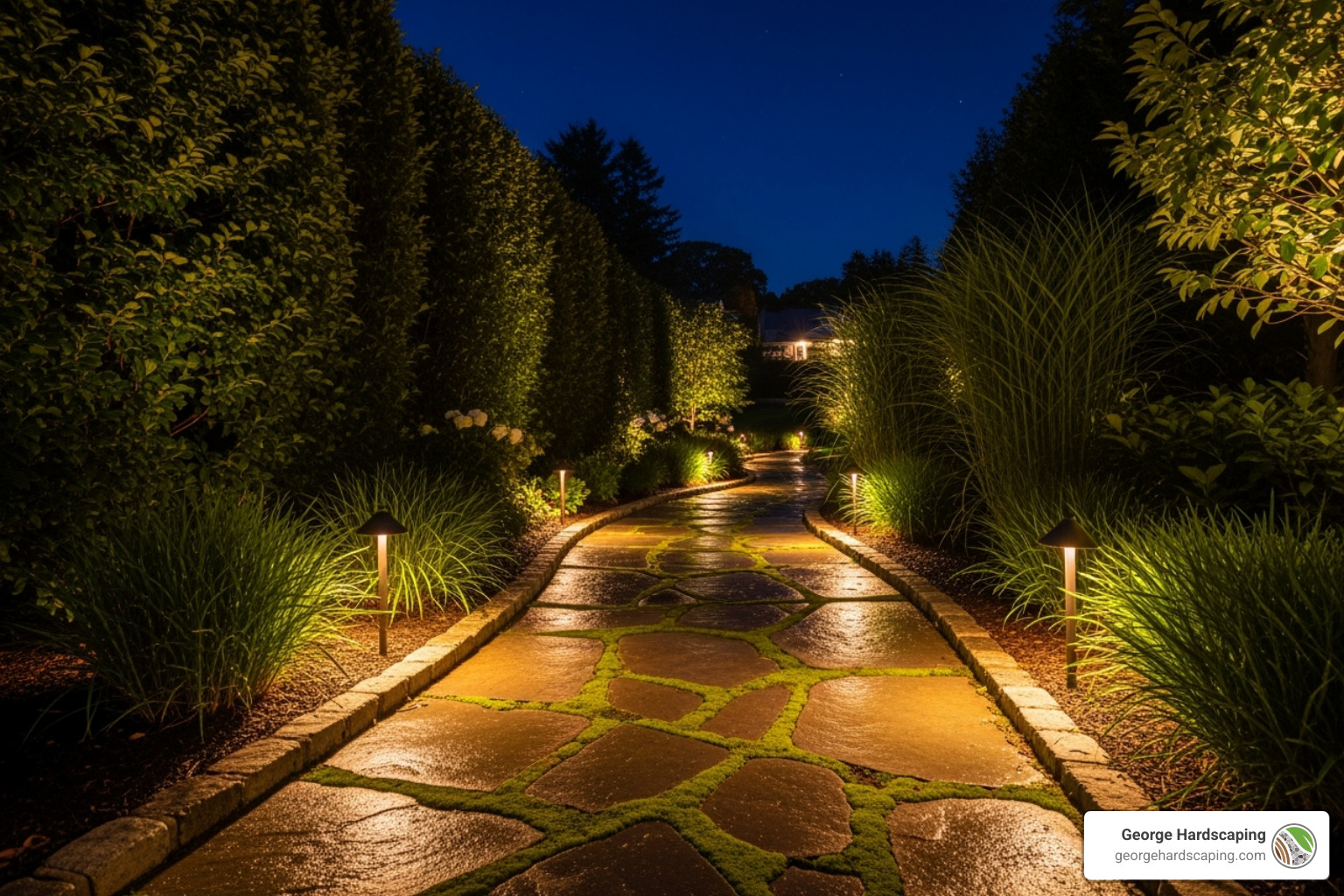
Planning for additional features during the initial construction phase can improve your walkway’s enjoyment and long-term value while being more cost-effective than adding them later.
- Stone steps are essential for changes in elevation, creating a seamless flow. Costs vary widely based on material, from $900-$2,700 for a bluestone staircase to $4,000-$12,000 for premium granite. Explore our Stone Steps Design Ideas for inspiration.
- Edging provides a finished look and prevents stones from shifting. Costing $5-$18 per linear foot, it’s a small investment that protects the structural integrity of your walkway.
- Landscape lighting improves safety and creates a stunning evening feature. Low-voltage lighting installation averages $80-$300 per fixture, highlighting your stone’s natural texture after dark.
- Sealant application protects porous stones from stains and weather damage. At $2-$10 per square foot, sealing extends your walkway’s life and is typically reapplied every one to five years.
Comparing Stone to Other Walkway Materials
Understanding how natural stone compares to other options highlights its value.
- Concrete walkways are cheaper upfront ($7-$17 per sq. ft.) but are vulnerable to cracking in New England’s freeze-thaw cycles, leading to costly repairs or replacement. Reliable data from the American Concrete Institute shows freeze-thaw damage as a top cause of concrete failure in cold climates.
- Manufactured pavers ($10-$20 per sq. ft.) offer design flexibility and easier repairs than poured concrete but lack the unique character and patina of natural stone.
- Gravel walkways are the most budget-friendly option ($1-$3 per sq. ft.) but require more maintenance and are less stable.
While stone costs more initially, its lifespan of 20 to 100+ years, low maintenance, and significant boost to curb appeal provide an excellent return on investment.
DIY vs. Professional: Analyzing the Cost to Install Stone Walkway
While a DIY approach seems like a way to save on the cost to install stone walkway, it’s more complex than it appears. Material and tool rental costs can be surprisingly high, and the project requires a significant time commitment (often 40-50 hours) and specialized skills.
Improper installation is a major risk. Common DIY mistakes like inadequate base preparation or poor drainage can lead to settling, shifting, and water damage, requiring expensive professional repairs later.
Hiring a professional ensures the job is done right. We bring years of experience, the proper equipment for efficiency, and the expertise to create a durable, beautiful walkway that increases your home’s value. Professionals also provide warranties, giving you peace of mind. For a project of this scale, working with an experienced Hardscaping Contractor is the smarter long-term investment.
Frequently Asked Questions about Stone Walkway Installation
Homeowners considering a stone walkway often have questions. Here are answers to the most common ones we hear in Essex County.
How long will a natural stone walkway last?
One of the biggest advantages of investing in a stone walkway is its incredible longevity, which makes the cost to install stone walkway a smart long-term investment. With proper installation, a natural stone walkway can last 20 to 100 years.
The specific lifespan depends on the stone. Granite is the most durable, easily lasting 50-100+ years. Bluestone and slate are also very tough, typically lasting 50-75 years. Softer stones like limestone and sandstone have a lifespan of 20-50 years and require a bit more care.
However, the installation quality is paramount. A solid, well-drained base of compacted gravel and sand is essential to prevent shifting and cracking. Regular maintenance, such as cleaning and resealing porous stones every 1-5 years, will protect your investment and extend its life.
Do I need a permit for a stone walkway in Massachusetts?
Whether you need a permit depends on your project’s specifics and your town’s regulations on the North Shore. Most simple, on-property walkways do not require a permit.
However, you will likely need a permit if your walkway:
- Connects to a public sidewalk or street.
- Involves significant grading that alters water drainage.
- Includes structural elements like steps at a main entrance.
- Is part of a larger project that already requires a permit.
Always check with your local building department before starting. Permit costs can range from $200 to $1,000 or more for complex projects. While it adds to the cost, securing a permit avoids potential fines and the risk of having to remove the work. We help our clients steer the permitting process.
What is the best way to de-ice a stone walkway without damaging it?
Using the right de-icing product is crucial to protect your stone investment, a practice supported by environmental authorities like the U.S. Environmental Protection Agency (EPA) which provides guidance on safer de-icing. Avoid traditional rock salt (sodium chloride), as it is highly corrosive and can cause the stone to flake, discolor, and crumble (a process called spalling).
Instead, use safer alternatives:
- Magnesium chloride and calcium chloride are effective ice melters that are much gentler on stone.
- Potassium chloride is another gentle option, though less effective in very cold temperatures.
- For chemical-free traction, plain sand is an excellent choice. It won’t melt ice but provides a non-slip surface.
The best strategy is prevention. Shovel snow promptly before it can compact and turn to ice. This minimizes the need for de-icing products and keeps your walkway in pristine condition for years to come.
Conclusion
When you consider the cost to install stone walkway, you are looking beyond a simple expense and making a long-term investment in your home’s future.
As we’ve covered, costs are influenced by your choice of stone, design complexity, and site conditions. However, the true value of a stone walkway lies in its longevity. A granite or bluestone path can welcome guests to your home for decades, potentially for 100 years or more—a level of durability that other materials can’t match.
With minimal maintenance and exceptional resilience, a professionally installed stone walkway offers a compelling return. It doesn’t just connect two points; it lifts your home’s first impression and can significantly boost its property value.
For homeowners in Essex County and the North Shore of Massachusetts, we understand how to build walkways that endure our unique New England climate. We know which stones and installation methods will stand the test of time. Every project is unique, and we take the time to understand your vision and recommend solutions that fit your home and budget.
What to Expect From a Professional Estimate
A thorough estimate should cover more than square footage. Our process begins with a site visit where we assess soil conditions, drainage patterns, and access points. We then provide a written proposal outlining:
- Detailed material quantities and selections.
- Base preparation specifications (depth, aggregate type, compaction standards).
- A clear installation timeline—most 100-square-foot walkways take three to five working days, while larger, more intricate builds may span one to two weeks.
- Itemized costs for labor, materials, and any optional add-ons such as lighting or steps.
- Warranty terms—our craftsmanship warranty typically covers a full five years against settling or joint failure.
This transparency ensures you understand exactly where every dollar goes and empowers you to make informed decisions.
Final Thoughts
By budgeting wisely, selecting the right stone, and partnering with experienced professionals, you can achieve a walkway that improves your property’s beauty and functionality for generations. Ready to transform your home’s entrance with a beautiful, lasting stone walkway?
Contact us for a professional walkway estimate
