
Commercial Sidewalk Snow Removal: Ultimate Safety 2025
Beyond the Shovel: Protecting Your Business This Winter
Image metadata: Title: Commercial Sidewalk Snow Removal at Dawn; Alt: A facility manager oversees commercial sidewalk snow removal at dawn, ensuring safe pedestrian access in front of a retail plaza; Caption: Safe, accessible sidewalks are essential for customer, employee, and delivery access after overnight snowfall; Source: George Hardscaping media library; Photographer: In-house; Location: Essex County, MA; Dimensions: 1600×900; License: Used with permission by George Hardscaping
Commercial sidewalk snow removal is a critical responsibility that can influence safety, operations, and revenue throughout the winter. The stakes are real: even a single slip-and-fall claim may cost tens of thousands of dollars in legal fees and settlements, and a day of limited access can disrupt sales, medical appointments, deliveries, and staff attendance. In Massachusetts, many municipalities require timely snow and ice clearance along public-facing sidewalks, and case law places a duty on property owners to keep premises safe from snow and ice hazards. Always consult your local ordinances, and review guidance such as the Commonwealth’s consumer resources on snow and ice responsibilities to ensure compliance.
Winter weather does not pause for business hours, so your strategy must extend beyond “shovel and salt.” A practical plan accounts for storm timing, snow types, ice prevention, surface protection, staffing, equipment capacity, and documentation. Whether you manage a high-traffic storefront in Salem, a professional office in Peabody, or a large multi-tenant complex elsewhere on the North Shore, the right approach balances efficiency, cost control, and liability reduction.
Today’s best practices combine specialized machinery, smart de-icing chemistry, and documented processes that stand up to scrutiny. For many organizations, outsourcing to a professional partner is the most reliable way to achieve consistency before opening hours and throughout extended events. If you want to secure predictable service levels and relieve internal teams from middle-of-the-night call-outs, consult a provider with the right equipment and coverage. Learn more about specialized support with George Hardscaping’s commercial solutions at https://georgehardscaping.com/commercial-snow-clearing/ and our fleet-based response capabilities at https://georgehardscaping.com/snow-plowing-services/.
Pro tip for decision-makers: schedule a pre-season site walk and hazard audit before the first freeze. Map walkways, entrances, ramps, curb cuts, loading zones, and emergency exits; flag sensitive materials like pavers; and set your performance standards. If you need a structured framework for operations and documentation, review our commercial snow removal agreements at https://georgehardscaping.com/commercial-snow-removal-contracts/.
The Slippery Slope: Key Challenges of Commercial Sidewalk Management
For businesses in Essex County and across the North Shore, commercial sidewalk snow removal is complex and time-sensitive. The first challenge is liability. In Massachusetts, property owners have a duty to maintain reasonably safe premises, which includes addressing snow and ice accumulations. Local ordinances often mandate clearing within defined windows after a storm. Consult your municipality and state resources to confirm requirements and risk mitigation options. For broader safety guidance, the Occupational Safety and Health Administration provides winter hazard information for employers and workers at https://www.osha.gov/winter-weather. While laws vary across states—for example, New Jersey’s evolving case law around in-storm obligations noted in reputable legal reporting—Massachusetts property owners generally cannot rely on a “natural accumulation” defense and should plan for timely removal and ice treatment.
The physical realities of sidewalks present the second challenge. Pedestrian zones are narrow, full of pinch points, and peppered with obstacles—lamp posts, bollards, bike racks, benches, planters, utility pedestals, and drive-thru pads. Oversized or inappropriate equipment can damage fixtures and finishes or leave windrows that refreeze. Decorative surfaces—stamped concrete, exposed aggregate, and modular pavers—require particular care. Aggressive steel blades and improper de-icers can scuff surfaces, pop joints, or leave white spalling marks. The remedy is fit-for-purpose machinery with protective cutting edges and controlled application of de-icing materials.
Third, snow type and temperature swings complicate operations. Powder snow may be easily swept, but heavy, wet snow typical of coastal New England compacts into ice if not removed early. Freeze–thaw cycles turn slush into black ice overnight, especially in shaded areas and on north-facing paths. Pre-treatment can prevent bond formation, making subsequent plowing and sweeping more effective. Liquid brines—applied ahead of storms—limit ice adhesion and substantially reduce total salt usage.
Finally, logistics and cost control matter. A shovel-only approach strains teams and invites inconsistency. Productivity benchmarks show a single specialized sidewalk machine can replace multiple shovelers, reducing labor, exposure risk, and overtime. Operators can focus on priority areas before open hours and revisit hotspots throughout the day. If you manage multiple entrances or multi-building campuses, the capacity and routing advantages of a professional service can be decisive. Explore scalable sidewalk solutions and equipment options at https://georgehardscaping.com/commercial-snow-clearing/, and see how fleet deployment works in concert with lot operations at https://georgehardscaping.com/snow-plowing-services/.
What to document: time-stamped service logs, weather conditions, accumulation depths, de-icer types and rates, photos of conditions before and after treatment, and any incident reports. Clear documentation is a critical defense against liability claims and helps evaluate performance following each event. For insights on establishing service levels, scopes, and recordkeeping in your contract, review https://georgehardscaping.com/commercial-snow-removal-contracts/.
Helpful resources:
- OSHA Winter Weather Safety: https://www.osha.gov/winter-weather
- National Weather Service (forecasting and alert tools): https://www.weather.gov/
- National Safety Council on slip, trip, and fall prevention: https://www.nsc.org/safety-topics/slips-trips-and-falls
Gearing Up: Choosing the Right Equipment for the Job
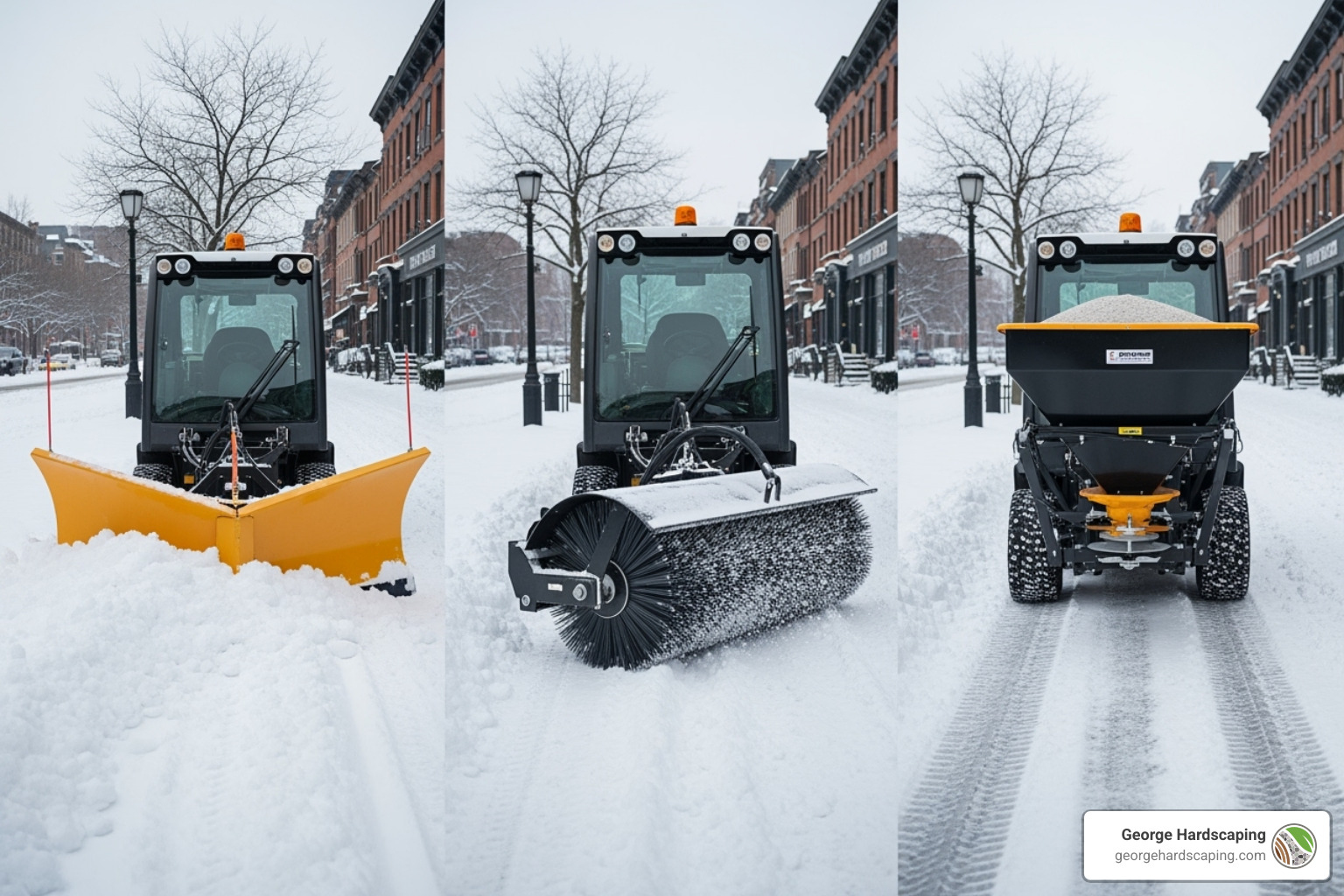
Image metadata: Title: Sidewalk Snow Removal Attachments; Alt: Collage of sidewalk-scale snow tools mounted on compact units: a V-plow with rubber edge, a power broom clearing light snow on pavers, and a drop spreader applying de-icer; Caption: Match machine width and attachment type to your pathways and surface materials for efficient, damage-free clearing; Source: George Hardscaping media library; Photographer: In-house; Location: North Shore, MA; Dimensions: 1600×900; License: Used with permission by George Hardscaping
Having the right equipment often determines whether your sidewalks are safe by opening bell. The goal is to match machine type, width, and attachment selection to your property’s geometry and surface materials while building an ice management plan that minimizes product use without compromising traction.
Modern sidewalk snow vehicles (SSVs) have reshaped best practices. Purpose-built, compact power units—whether stand-on, sit-down, or articulated—offer high maneuverability around street furniture and door approaches. Key features include:
- Narrow operating widths (about 36–46 inches) to pass benches, bollards, and narrow gates while still clearing a full pedestrian lane.
- Tight turning radius or articulation for navigating switchbacks and courtyard paths.
- Ergonomic, heated cabs or stand-on platforms to reduce fatigue in extended events.
- Lighting packages and guideing for pre-dawn or low-visibility operation.
Attachments and when to use them
- V-plows and straight blades: Fast at moving moderate accumulations. A V configuration punches through drifts and windrows at crosswalks; a straight blade is efficient for pulls along long, straight paths. Protect decorative surfaces by using rubber or polyurethane cutting edges and shoes set to the correct height.
- Power brooms: Ideal for light to moderate powder and for finishing passes on sensitive pavers or stamped concrete. Brooms remove residual snow without scraping, leaving a near-dry surface that is less prone to refreeze.
- Two-stage snow blowers: Best when you must throw snow off the path entirely—useful in tight corridors with nowhere to push snow or when building snow storage along curbs would block ADA routes.
- Drop spreaders: Deliver de-icer exactly where pedestrians step, not into planting beds or parking stalls. This precision reduces product use and springtime landscape damage.
- Brine sprayers: Enable pre-treatment and one-pass plow-and-treat operations. Liquids create a barrier layer that prevents bonding, decreases refreeze, and can cut granular salt requirements significantly.
Why parking-lot gear fails on sidewalks
- Size and weight: Even compact truck plows can be too wide, risking damage to bollards, benches, railing posts, and steps.
- Edge aggression: Uncushioned steel edges scar pavers, chip curbs, and loosen joint sand.
- Product waste: Broadcast spreaders fling salt into landscapes and entry mats, increasing clean-up and corrosion.
Surface preservation strategies
- Pair plows with compliant edges (rubber or polyurethane) and set shoes to avoid catching high points.
- Favor brooms for sensitive materials near entrances and outdoor stairs; see our hardscape care guidance at https://georgehardscaping.com/walkways-stairs/.
- Use drop spreaders for granular de-icers and brine for pre-treatment on high-traffic routes leading to primary entrances.
Ice management and material selection
- Granular sodium chloride: Economical, effective above roughly 15–20°F. Consider treated salt for improved performance and reduced scatter.
- Calcium chloride or magnesium chloride: Effective at lower temperatures but more expensive; use sparingly and target only the slickest zones.
- Sand or grit: Adds traction when temperatures are too low for chemical action, but requires extra cleanup and can clog drains.
- Liquid brine (e.g., 23% NaCl): For anti-icing and bond prevention. Reduces total salt usage and speeds post-storm cleanup.
Operational efficiency gains
- A single SSV with plow and drop spreader can clear long runs of sidewalk and treat them in one pass, often replacing several shovelers and a separate salting crew.
- Route sequencing matters. Open primary entrances, ADA ramps, and transit stops first; widen secondary paths as the storm progresses; finish with detail work around door thresholds and steps.
- Documented service beats ad hoc efforts. Equip operators with a simple checklist to confirm attachment choice, treatment rates, and pass counts for each zone.
If your property mix includes sidewalks, short service drives, and plazas, a blended equipment strategy usually wins: an SSV for tight pedestrian areas and a plow or loader for larger pushes and snow relocation. For a turnkey, equipment-backed approach that scales up during major events, see our capabilities at https://georgehardscaping.com/snow-plowing-services/ and sidewalk-focused offerings at https://georgehardscaping.com/commercial-snow-clearing/.
The Strategic Approach to Commercial Sidewalk Snow Removal
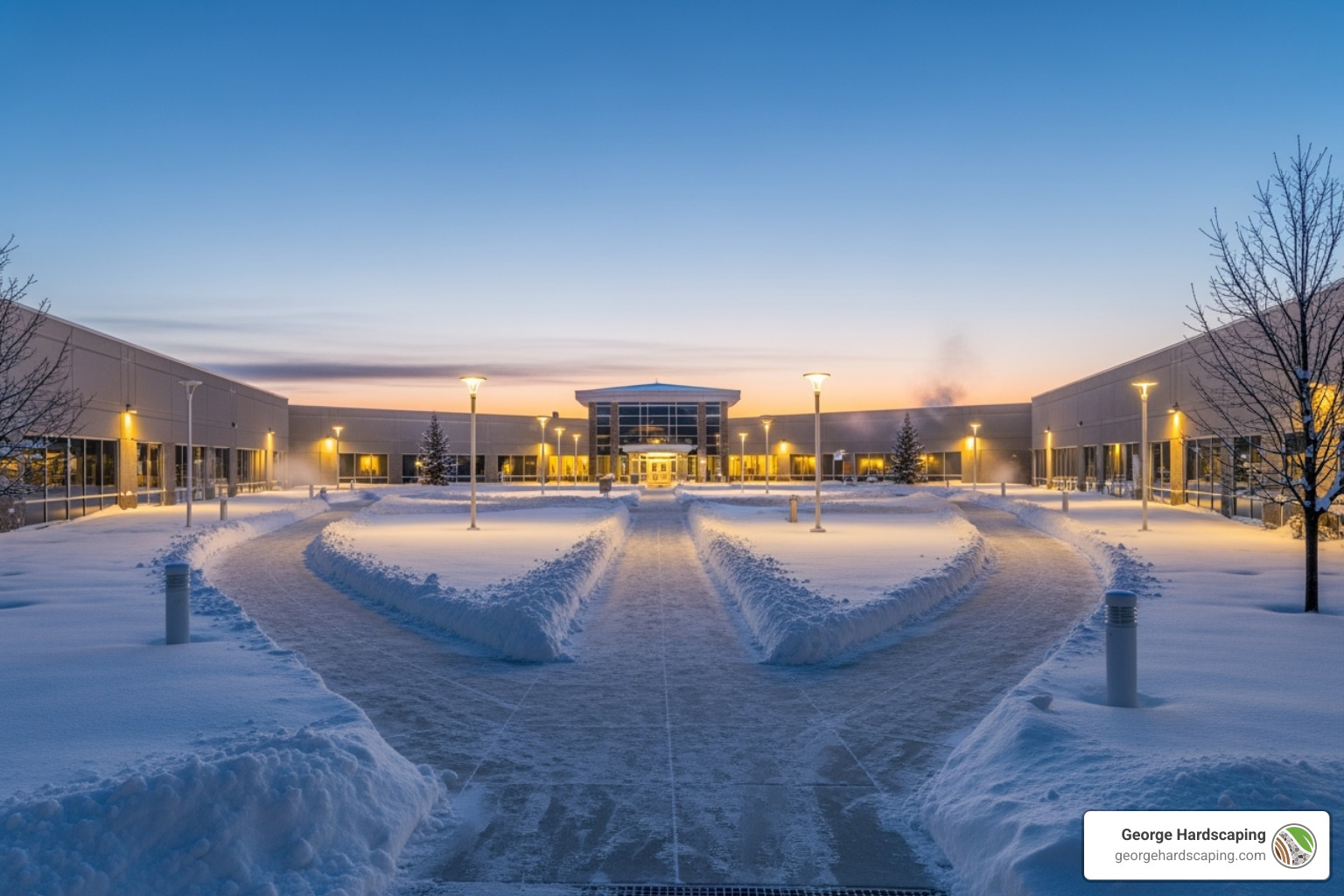
Image metadata: Title: Daybreak Sidewalk Safety After Snow; Alt: A commercial property at daybreak with clean, de-iced sidewalks, cleared curb cuts, and visible safety signage after an overnight snow event; Caption: A proactive, documented snow and ice plan keeps entrances, ADA routes, and loading areas safe and open before business hours; Source: George Hardscaping media library; Photographer: In-house; Location: Essex County, MA; Dimensions: 1600×900; License: Used with permission by George Hardscaping
Effective commercial sidewalk snow removal relies on an intentional plan—built weeks before the first flurries—that aligns staffing, equipment, and communications with your business hours and risk tolerance. The fundamentals below help keep people safe, control costs, and reduce liability.
1) Conduct a fall site assessment
- Map assets: Identify all sidewalks, crosswalks, curb cuts, stairs, ramps, loading docks, transit stops, and emergency egress routes.
- Classify priorities: Tier entrances and paths by urgency (e.g., Tier 1: primary customer entry and ADA ramps; Tier 2: employee entrances and secondary routes; Tier 3: decorative plazas and overflow access).
- Note hazards: Heaving slabs, uneven pavers, drainage issues, chronic freeze zones, downspouts discharging across walks, and tight turns that limit equipment options.
- Choose methods: Assign the best attachment and de-icer for each surface type. For delicate hardscapes, plan for broom-first passes and drop-spread treatments.
2) Define your service triggers and tolerances
- Accumulation triggers: Many properties trigger sidewalk service at 1 inch of snowfall; high-traffic sites or health facilities may set a zero-tolerance standard to maintain bare pavement during active storms.
- Timing: Establish pre-treatment thresholds (e.g., liquid brine 12–24 hours before a forecasted event when surfaces are dry and temperatures are above the brine’s practical working limit).
- End-of-storm response: Specify the timeframe for final clean-up, widening, and ice patrols after the snow stops.
3) Build an operations playbook
- Route plans: Assign machines and operators to defined zones with estimated cycle times based on machine width and expected accumulation.
- Materials plan: Pre-stage salt or brine, calibrate drop spreaders, and document target application rates for typical temperatures.
- Communications: Define who triggers service, who monitors weather, and how updates are shared during overnight events. The National Weather Service provides local forecasts and alerts at https://www.weather.gov/.
- Documentation: Use a simple digital log to record arrival/departure times, attachments used, material types and rates, and photos. Your logs are vital in defending against claims and verifying performance.
4) Control the ice curve
- Anti-ice early: Pre-treat high-traffic routes and known freeze zones before the event to prevent bond formation and reduce chemical use later.
- Plow/broom often: Maintain passable widths during the storm so accumulations never become unmanageable.
- Patrol post-storm: Revisit shaded areas, cart corrals, curb returns, and entries where foot traffic compacts slush that can refreeze.
5) Budget with the full picture in mind
- Ownership costs: A quality sidewalk machine can cost several thousand to tens of thousands of dollars, plus maintenance, storage, fuel, and training.
- Staffing realities: Night and weekend coverage, call-outs, and extended-duration storms require reliable labor; fatigue management and safety training are non-negotiable.
- Liability transfer: Hiring a reputable, insured service moves significant risk off your balance sheet while providing predictable service levels. For guidance on structuring contracts that define scope, timing, materials, and documentation, see https://georgehardscaping.com/commercial-snow-removal-contracts/.
- Pricing intelligence: Understanding how vendors price per push, per event, seasonal, and hybrid models helps you choose a plan that matches your risk profile. See our explainer at https://georgehardscaping.com/how-to-price-commercial-snow-removal/.
6) Protect your hardscape investment
- Match edges to surfaces: Rubber or polyurethane edges plus properly set shoes prevent surface gouging and joint displacement.
- Favor brooms near thresholds: A broom leaves a cleaner finish on pavers and steps, minimizing salt burn and springtime restoration.
- Calibrate de-icers: Use drop spreaders to avoid overspray into planting beds and reduce corrosion around metal handrails and door hardware. For design or repair of walkways and steps to perform better in winter, visit https://georgehardscaping.com/walkways-stairs/.
If your team prefers a turnkey, on-call approach with documented service and dedicated equipment, a partner can help you formalize the plan described above and execute it consistently. Learn how our crews integrate sidewalk operations into full-site storm response at https://georgehardscaping.com/snow-plowing-services/ and see our sidewalk-focused offerings at https://georgehardscaping.com/commercial-snow-clearing/.
CTA: Want a site-specific sidewalk plan before the first storm? Schedule a pre-season walk-through and proposal at https://georgehardscaping.com/contact-us/.
Additional resources:
- OSHA Winter Weather (planning, PPE, and worker safety): https://www.osha.gov/winter-weather
- National Weather Service (hourly forecasts, alerts, radar): https://www.weather.gov/
Frequently Asked Questions about Sidewalk Snow Removal
Business owners across Essex County and the North Shore often ask similar questions about keeping pedestrian routes safe. Here are detailed answers to the three we hear most often.
What is the best machine for clearing snow from commercial sidewalks?
There is no universal best; match the tool to your property. In areas with tight furniture layouts, frequent door thresholds, and short runs between entries, a dedicated Sidewalk Snow Vehicle (SSV) with a rubber-edged V-plow and a quick-swap broom is typically the most productive and gentle on surfaces. For long, straight walkways—such as along corporate campuses or big-box storefronts—compact tractors or UTVs with plows can be efficient, provided they are narrow enough to pass obstacles without leaving windrows. When snow storage space is limited, two-stage blowers are invaluable for throwing snow out of the pedestrian envelope. If you’re unsure what mix is right for your sites, our team can spec a configuration and routing plan; see our capabilities at https://georgehardscaping.com/commercial-snow-clearing/ and fleet operations at https://georgehardscaping.com/snow-plowing-services/.
How can I prevent damage to my decorative walkways and pavers during snow removal?
Surface protection is a design plus operations challenge. Start with the right edges—rubber or polyurethane—on plows, and use shoes to keep cutting edges just above textured finishes. For finishes near entrances and stairs, prioritize brooms for most passes to avoid scraping joint lines. Apply de-icers with drop spreaders to prevent burn marks on adjacent plantings and to reduce corrosion near railings. If you’re considering upgrading or repairing walkways to perform better during freeze–thaw cycles, explore our construction and remediation options at https://georgehardscaping.com/walkways-stairs/.
Is hiring a professional service more cost-effective than buying my own equipment?
In many cases, yes—particularly when factoring in reliability and liability. Purchasing equipment brings recurring costs: maintenance, storage, fuel, insurance, operator training, and the challenge of staffing overnight and weekend storms. A qualified provider brings purpose-built machines, trained operators, documented processes, and insurance that can transfer a significant portion of risk. You also gain predictable service windows and response standards. For help evaluating service models—per-push, seasonal, or hybrid—visit https://georgehardscaping.com/how-to-price-commercial-snow-removal/ and discuss options with our team at https://georgehardscaping.com/contact-us/.
Need help fast? Find reliable coverage in your area at https://georgehardscaping.com/snow-removal-near-me/.
Conclusion: Ensure Safe Passage with Professional Snow Management
Commercial sidewalk snow removal touches safety, operations, customer experience, and brand reputation. The combination of narrow pathways, sensitive finishes, freeze–thaw cycles, and strict opening-hour deadlines makes sidewalks one of the most challenging aspects of winter property care. A modern program blends the right machines and attachments, targeted anti-icing and de-icing, and a documented playbook that proves diligence if an incident occurs.
If you prefer predictability, an experienced partner can take ownership of these outcomes—planning routes, calibrating materials, pre-treating before storms, and patrolling for refreeze. That’s the approach we bring to properties across the North Shore and Essex County, with sidewalk-dedicated equipment and service standards set for early-morning readiness. Explore our offerings at https://georgehardscaping.com/commercial-snow-clearing/ and https://georgehardscaping.com/snow-plowing-services/.
Ready to ensure your sidewalks are clear, safe, and open—no matter when the snow falls? Request a site walk and custom plan today at https://georgehardscaping.com/contact-us/.
Prefer to compare service models first? Review our guide at https://georgehardscaping.com/how-to-price-commercial-snow-removal/ and see area availability at https://georgehardscaping.com/snow-removal-near-me/.
